 Dou Dou (豆豆)
《粗齋》沒有山珍海味,卻憑一鍋南乳和幾樣乾貨,把樸素食材燉成節慶餐桌上的主角。This timeless Cantonese festive stew transforms a handful of dried pantry staples into a rich, glossy, no-meat centerpiece.
📹 Watch the Recipe
Full demonstration from 素食教煮 Veggie So Easy:
🥘 Why This Recipe Works
南乳粗齋 (nam yu sau jai) is one of Cantonese vegetarian cooking’s greatest achievements. It starts with the star — 南乳, a block of fermented red bean curd whose deep, savory, faintly sweet character anchors the entire dish. Fry it briefly and the whole kitchen fills with that unmistakable, mildly funky fragrance.
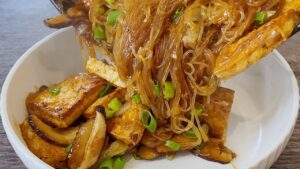
The dried goods do the heavy lifting: 木耳 wood ear adds a crisp bite, 金針 lily flowers bring a delicate chew, 枝竹 bean curd sticks drink up the sauce like little sponges, and 粉絲 vermicelli binds everything into one glossy whole. Braised together in a single wok, every mouthful carries the same rich, fermented, gravy-soaked flavor.
11 pantry ingredients, one wok, and about 30 minutes take you from soaked dried goods to a holiday-worthy dinner that makes a simple bowl of rice feel special.
🛒 Ingredients
| Ingredient | Amount | Notes |
|---|---|---|
| Fermented red bean curd (南乳) | 2 cubes | lightly mashed with its liquid |
| Red fermented bean curd liquid (南乳汁) | 1 tbsp | for color and depth |
| Dried shiitake mushrooms (冬菇) | 6 | soaked, sliced |
| Dried wood ear mushrooms (木耳) | 1 cup soaked | soaked, trimmed |
| Dried lily flowers (金針) | 8–10 | soaked, optional knot |
| Dried bean curd sticks (枝竹/腐竹) | 2 sheets | soaked, cut into lengths |
| Mung bean vermicelli (粉絲) | 1 small bundle | soaked |
| Napa cabbage or Chinese leaf (黃芽白) | 4 cups chopped | the bulk of the dish |
| Carrot (紅蘿蔔) | 1 | sliced, for sweetness and color |
| Sliced ginger (薑) | 4 slices | aromatics |
| Light soy sauce (生抽) | 1 tbsp | seasoning |
| Rock sugar (冰糖) | 1 tsp | balances the saltiness |
| Sesame oil (麻油) | 1 tsp | to finish |
| Cooking oil (食用油) | 1 tbsp | for frying |
👨🍳 Instructions
Step 1 · Soak the dried goodies
- Cover the dried mushrooms, wood ear, lily flowers, bean curd sticks, and vermicelli separately in cold water for 30–40 minutes.
- Drain and squeeze dry. Slice the mushrooms, trim the wood ear into bite-sized pieces, and cut the bean curd sticks into 5–6 cm lengths.
- Strain and reserve the mushroom soaking water — it becomes the braising liquid.
Step 2 · Mash the fermented bean curd
- In a small bowl, mash the nam yu cubes with their liquid into a smooth paste.
- Loosen with a spoonful of the reserved mushroom water so it stirs easily.
Step 3 · Fry the aromatics and nam yu
- Heat the oil in a wok over medium heat and stir the ginger slices until fragrant.
- Add the mashed nam yu and stir-fry about 30 seconds, until it turns glossy and the kitchen smells deeply savory.
Step 4 · Add the vegetables
- Add the soaked mushrooms, wood ear, carrot, and chopped cabbage.
- Stir-fry 2–3 minutes so everything is coated and glossy, then season with the soy sauce.
Step 5 · Braise in mushroom water
- Pour in about 2 cups of strained mushroom soaking liquid (top up with water to nearly cover).
- Add the rock sugar, bring to a gentle simmer, cover, and braise 8–10 minutes until the vegetables are tender and the gravy is rich.
Step 6 · Finish with vermicelli
- Add the soaked bean curd sticks and vermicelli, stirring to submerge them in the gravy.
- Cook 2–3 minutes until the vermicelli is springy and has thickened the sauce.
- Drizzle with sesame oil, toss once, and serve hot over rice.
💡 Tips & Substitutions
| Problem / Question | Fix / Answer |
|---|---|
| No fermented red bean curd on hand? | Use 1.5 tbsp of another fermented tofu brine, or mix white miso with a dash of Chinese cooking wine — flavor will be a bit milder. |
| Dish turns out too salty? | Rinse the nam yu cubes before mashing, hold the soy sauce until after braising, or add a little more rock sugar. |
| Can I add other vegetables? | Yes — snow peas, cauliflower, tofu puffs, or fried bean curd all work; add the quick-cooking ones near the end. |
| Is this only for Chinese New Year? | 粗齋 is the classic lunar New Year and vegetarian-day staple, but it’s enjoyed year-round across Cantonese households. |
📊 Nutrition
Per serving (approx.): ~210 kcal · 8 g protein · 11 g fat · 24 g carbohydrates.
Ingredients
Method
- Cover the dried mushrooms, wood ear, lily flowers, bean curd sticks, and vermicelli separately in cold water for 30-40 minutes. Drain, squeeze dry, slice mushrooms, trim wood ear, and cut bean curd sticks into 5-6 cm lengths. Strain and reserve the mushroom soaking water for the braise.
- In a small bowl, mash the nam yu cubes with their liquid into a smooth paste, loosening with a spoonful of reserved mushroom water.
- Heat oil in a wok over medium heat and stir the ginger until fragrant. Add the mashed nam yu and stir-fry 30 seconds until glossy and deeply savory.
- Add the soaked mushrooms, wood ear, carrot, and chopped cabbage. Stir-fry 2-3 minutes to coat, then season with the soy sauce.
- Pour in about 2 cups of strained mushroom soaking liquid, top up with water if needed to nearly cover. Add rock sugar, bring to a gentle simmer, cover, and braise 8-10 minutes until tender and glossy.
- Add the soaked bean curd sticks and vermicelli, submerging them in the gravy. Cook 2-3 minutes until springy and the sauce thickens. Drizzle with sesame oil, toss once, and serve hot over rice.
🌱 Why This Dish
《齋》(zhāi) literally means vegetarian or fasting — the mindful, meat-free food eaten during Buddhist vegetarian observance (素食). 粗齋 is the everyday family pot enjoyed on the 1st and 15th of each lunar month (初一十五) and especially during Lunar New Year, when starting the year with vegetables is said to bring a clean and auspicious beginning.
The 南乳 (southern fermented red bean curd) points to its Cantonese (南) roots. A beloved “temple dish,” it has long been served at monasteries and festive Buddhist gatherings across southern China and Hong Kong — living proof that a table needs no meat to be generous.
Because every ingredient is a dried pantry staple that keeps for months, the dish symbolizes abundance, frugality, and the remarkable resourcefulness that defines Cantonese home cooking.