 Dou Dou (豆豆)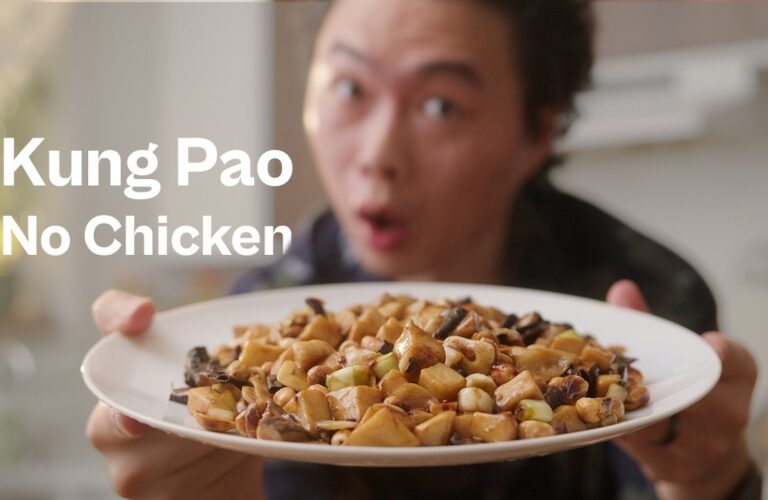
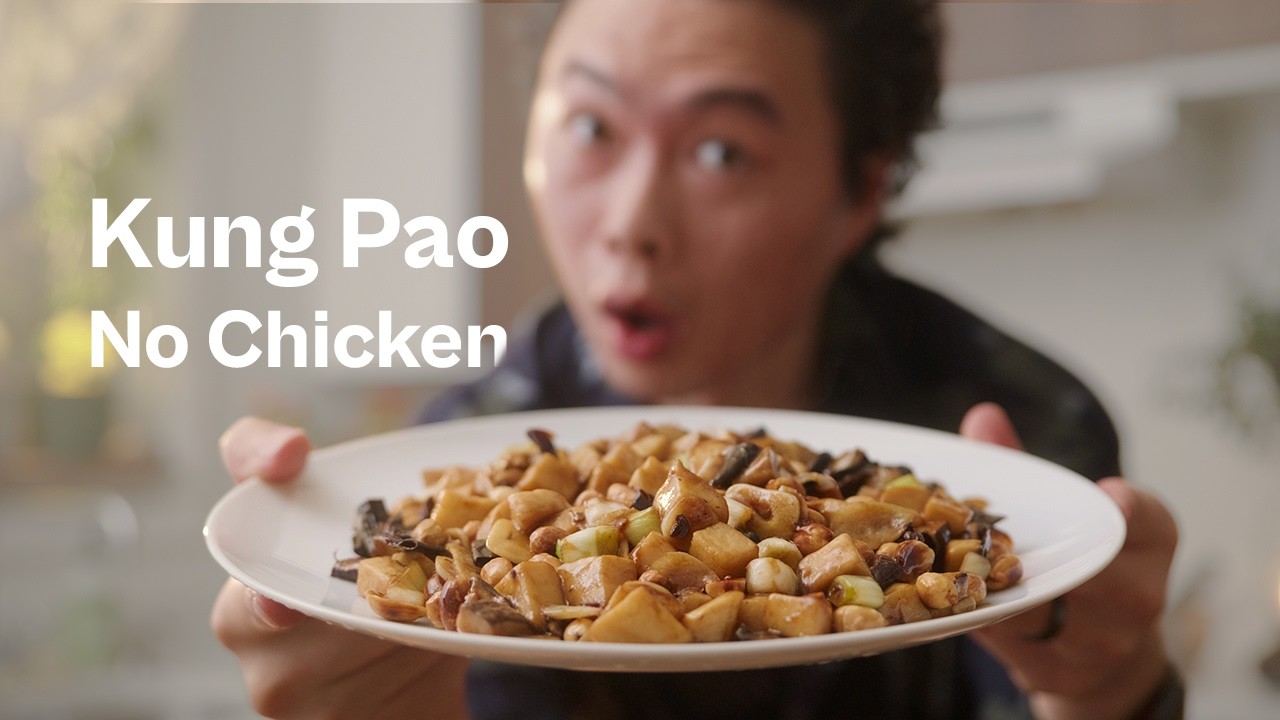
Kung Pao chicken, rebuilt entirely from plants — glazy, tender king oyster mushrooms bathed in a real Sichuan sweet-sour sauce that stays spicy and never turns soggy. 用杏鲍菇重现宫保鸡丁的滑嫩与油亮,酸甜麻辣的川味酱汁只靠六样调料。
📹 Watch the Recipe
Recipe by Lionel Zeng
🥘 Why This Recipe Works
Kung Pao (宫保 / Gōngbǎo) has always been a texture dish — the pleasure is the snap of the leek, the crunch of toasted peanuts, and the way the sauce clings to every piece instead of pooling at the bottom of the wok. Swap in king oyster mushroom and you keep all of that. Sliced into one-inch cubes, its dense, fibrous stalk has the bite of meat, and unlike ordinary button mushrooms it holds its shape through high heat instead of collapsing into water.
The sauce is where most home versions go wrong. A proper Kung Pao is balanced across four sensations at once — sour 酸, sweet 甜, spicy 辣, and numbing 麻 — and here that comes from just six pantry items: Chinkiang black vinegar for the tart backbone, sugar for roundness, light soy for salt, a whisper of dark soy for the lacquered color, Shaoxing wine for depth, and a cornstarch slurry to thicken it into a glossy glaze. Nothing else is needed.
The technique is classic Sichuan wok work: infuse the oil with Sichuan peppercorns and dried chilies first, keep the mushroom on high heat so it sears rather than steams, and fold the peanuts in off the flame so they stay crisp. This version: 11 ingredients, one pan, 20 minutes.
🛒 Ingredients
Kung Pao Sauce
| Chinese black vinegar (镇江香醋) | 1 tbsp | Chinkiang vinegar — the sour backbone; balsamic is a distant substitute |
| Sugar (白糖) | 1 tbsp | Balances the vinegar; use white or rock sugar |
| Light soy sauce (生抽) | 1 tbsp | Seasoning and umami |
| Shaoxing wine (绍兴酒) | 1 tsp | Adds aroma; dry sherry works in a pinch |
| Dark soy sauce (老抽) | 1 tsp | For the deep glossy color, not much salt |
| Cornstarch + water (玉米淀粉) | 2 tsp + 1 tbsp | Slurry to thicken the glaze; stir again before use |
Stir-Fry
| King oyster mushrooms (杏鲍菇) | 3 large, cut into 1-inch cubes | The “meat” — dense stalk holds its bite |
| Raw peanuts (生花生) | 1/2 cup (40g) | Toasted dry first; go in last to stay crunchy |
| Chinese leek / da cong (大葱) | 1 stalk, cut into 1/2-inch pieces | Sweet allium snap; substitute the white of 3 scallions |
| Ginger (姜) | 1 thumb, sliced | Aromatics base |
| Garlic (蒜) | 4 cloves, sliced | Aromatics base |
| Dried red chilies (干辣椒) | 10–15, snipped into 1-inch pieces | Heat and fragrance; shake out seeds for less fire |
| Sichuan peppercorns (花椒) | 1 tbsp | The numbing 麻 element; bloomed in oil |
| Neutral oil (植物油) | 2 tbsp | Peanut, canola, or rice bran oil |
| Steamed jasmine rice (米饭) | to serve | Sauce-soaked rice is non-negotiable |
👨🍳 Instructions
Step 1: Mix the Kung Pao sauce
- In a small bowl, combine the black vinegar, sugar, light soy, Shaoxing wine, and dark soy.
- Stir in the cornstarch slurry until smooth and set aside — you’ll stir it again right before pouring.
Step 2: Toast the peanuts
- Place the raw peanuts in a dry pan over medium-low heat.
- Toast for about 5 minutes, tossing often, until lightly golden and fragrant. Remove and set aside.
Step 3: Bloom the aromatics
- Heat the oil in a wok over medium heat.
- Add the Sichuan peppercorns, then the dried chilies, and sauté for about 15 seconds until deeply fragrant — do not let them blacken.
Step 4: Sear the mushrooms
- Turn the heat to high. Add the king oyster mushrooms and stir-fry for 1 minute to sear the edges.
- Add the garlic, ginger, and leek; cook 1–2 minutes more until the mushrooms are tender but still bouncy.
Step 5: Glaze
- Give the sauce one last stir and pour it in.
- Keep stirring until it thickens and coats everything in a shiny, clingy glaze.
Step 6: Finish with peanuts
- Add the toasted peanuts last, toss quickly to combine, and serve immediately with steamed rice.
💡 Tips & Substitutions
| Can I use regular mushrooms? | Button or shiitake will release water and go soft. King oyster (杏鲍菇) or another firm stalk mushroom is essential for the meaty texture. |
| Too spicy? | Shake the seeds out of the dried chilies and reduce to 5–6 pieces; the dish should be fragrant-hot, not punishing. |
| No Chinkiang vinegar? | Rice vinegar is the closest swap. Balsamic works but is sweeter and darker — cut the sugar slightly. |
| Sauce too thin or too thick? | It should coat the back of a spoon. Thin: add a splash of water. Thick: a few drops of hot water loosen it instantly. |
| Make it gluten-free? | Use tamari in place of both soy sauces and swap the Shaoxing for dry sherry. |
📊 Nutrition
Per serving (serves 2 as a main with rice)
~315 cal · Protein: 8g · Carbs: 16g · Fat: 25g · Fiber: 3g
Ingredients
Method
- In a small bowl, combine the black vinegar, sugar, light soy, Shaoxing wine, and dark soy. Stir in the cornstarch slurry until smooth and set aside — stir again right before pouring.
- Place the raw peanuts in a dry pan over medium-low heat. Toast for about 5 minutes, tossing often, until lightly golden and fragrant. Remove and set aside.
- Heat the oil in a wok over medium heat. Add the Sichuan peppercorns, then the dried chilies, and sauté for about 15 seconds until deeply fragrant — do not let them blacken.
- Turn the heat to high. Add the king oyster mushrooms and stir-fry for 1 minute to sear the edges. Add the garlic, ginger, and leek; cook 1–2 minutes more until tender but still bouncy.
- Give the sauce one last stir and pour it in. Keep stirring until it thickens and coats everything in a shiny, clingy glaze.
- Add the toasted peanuts last, toss quickly to combine, and serve immediately with steamed rice.
Notes
🌱 Why This Dish
Kung Pao takes its name from Ding Baozhen (丁宝桢), a Qing-dynasty official who served as governor of Sichuan and held the honorary title 宫保 — “Palace Guardian.” His household cook improvised a quick stir-fry of chicken, chilies, and peanuts that came to be called 宫保鸡丁, and the name stuck long after the title did. It is one of the few dishes whose identity lives entirely in its sauce: the four-part balance of 酸、甜、辣、麻 (sour, sweet, spicy, numbing) is the signature of the Sichuan kitchen.
In Chinese Buddhist vegetarian cooking, 宫保 is a favorite template for conversion, because the sauce does not depend on any animal flavor. 杏鲍菇 (king oyster mushroom) has become the standard stand-in — its Cantonese name 鮑魚菇 literally nods to abalone, and its firm stalk mimics the tender-chewy texture of chicken thigh far better than tofu. Temple and 素菜馆 (vegetarian restaurant) versions often make the 宫保 treatment with wheat gluten 麵筋 or potato cubes instead.
This is 素宫保 — “vegetarian Kung Pao” — a dish that shows how the meatless kitchen works at its best: keep the technique and the seasoning tradition intact, and let the ingredient change carry the dish. Served with white rice, it’s a weeknight staple across Chengdu and Chongqing, and proof that a Sichuan classics menu needs no meat at all.