 Dou Dou (豆豆)
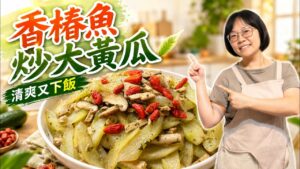
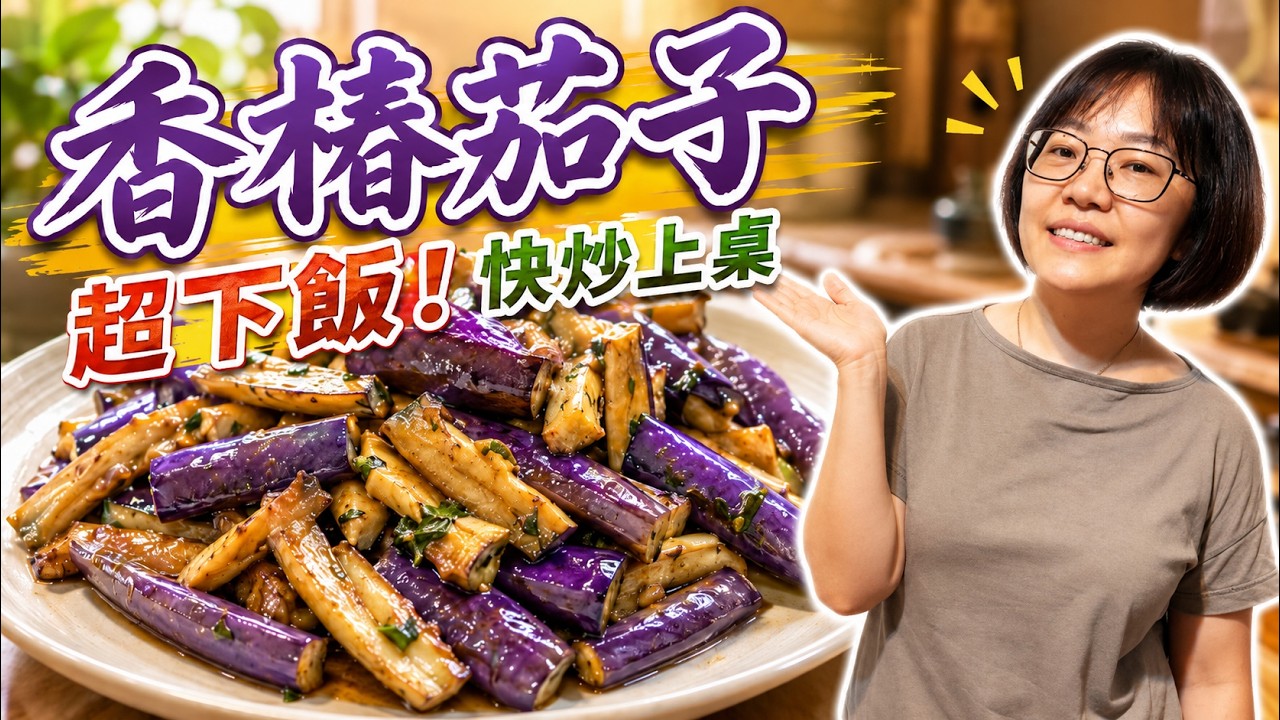
Silky golden eggplant, caramelized pressed tofu, and earthy mushrooms tossed in a fragrant toon-paste glaze — this spring stir-fry turns humble vegetables into the star of the dinner table. 香椿獨特的香氣裹著軟嫩茄子與焦香豆干,一盤樸實卻銷魂的純素家常菜,配白飯最對味。
📹 Watch the Recipe
Recipe by 芭樂媽的家 Qistin Wong TV
🥘 Why This Recipe Works
In Chinese kitchens, spring announces itself with the fragrance of 香椿 (xiāngchūn) — Chinese toon — the tender young shoots plucked from the toon tree. Known as the “tree vegetable” (樹上蔬菜), toon carries a bold, garlicky, almost meaty aroma that has flavored temple and home kitchens for centuries. Here it meets 茄子 (qiézi), the eggplant that soaks up flavor better than any other vegetable.
The secret is in the two-stage wok work. The eggplant is flash-fried briefly at high heat, which seals its skin, keeps the purple bright, and gives it a silky, custard-like interior without greasiness. The pressed tofu is seared until golden at the edges and pleasantly chewy, while shiitake and king oyster mushrooms add savory depth. Everything comes together in a glossy glaze of toon paste, vegan oyster sauce, and a touch of soy and sugar.
This version: 8 ingredients, one wok, 20 minutes.
🛒 Ingredients
| Eggplant (茄子) | 2 medium (about 400 g) | Cut into finger-length batons; Asian or Japanese varieties work best |
| Fresh shiitake mushrooms (鮮香菇) | 2 large | Sliced; stems included |
| King oyster mushrooms (杏鮑菇) | 150 g | Torn into thin shreds so they catch the sauce |
| Pressed tofu (豆干) | 2 pieces | Cut into batons; pan-seared until golden |
| Cooking oil (食用油) | Enough for shallow-frying | Neutral oil with a high smoke point |
| Toon paste (香椿醬) | 1 tsp | The star flavor; salty, so season carefully |
| Vegan oyster sauce (素蠔油) | 1 tbsp | Adds glossy umami depth |
| Soy sauce (醬油) | 1 tbsp | Light soy preferred |
| Sugar (糖) | 1 tsp | Balances the savory glaze |
👨🍳 Instructions
Step 1: Prep the vegetables
- Slice the eggplant into batons about 1 cm thick and 6-7 cm long.
- Slice the shiitake; tear the king oyster mushrooms into thin strips by hand; cut the pressed tofu into similar batons.
- Measure out the toon paste, vegan oyster sauce, soy sauce, and sugar — the final stir-fry is fast.
Step 2: Flash-fry the eggplant
- Heat oil in a wok over medium-high heat until a chopstick dipped in it bubbles immediately.
- Fry the eggplant in a single layer for 2-3 minutes until the skin turns glossy purple and the flesh softens.
- Scoop out with a slotted spoon and drain on paper towels.
Step 3: Sear the tofu and mushrooms
- In the same wok, pan-fry the pressed tofu until golden and caramelized at the edges.
- Add the shiitake and king oyster shreds; stir-fry until fragrant and lightly browned.
Step 4: Glaze and toss
- Return the eggplant to the wok with the toon paste, vegan oyster sauce, soy sauce, and sugar.
- Toss over medium-high heat for 1-2 minutes until every piece is coated in the glossy glaze.
- Serve immediately with steamed rice.
💡 Tips & Substitutions
| Why did my eggplant soak up too much oil? | Fry at properly high heat so the skin seals quickly, don’t crowd the wok, and drain on paper towels. Salting the batons for 10 minutes and patting dry before frying also helps. |
| I can’t find toon paste. | In spring, use 1 tablespoon of finely chopped fresh toon leaves instead. Out of season, substitute ½ teaspoon toasted sesame oil plus a pinch of five-spice, or use vegan XO sauce for a different but equally delicious glaze. |
| Can I make it lighter without deep-frying? | Yes — pan-fry the eggplant in 2 tablespoons of oil over medium-high heat, or steam the batons for 3 minutes first for a softer, oil-free version. |
| No pressed tofu on hand? | Use extra-firm tofu: press it, cut into batons, and pan-fry until golden. Thin strips of seitan also work. |
📊 Nutrition
Per serving (serves 3 as a side dish)
~210 cal · Protein: 9g · Carbs: 18g · Fat: 13g · Fiber: 6g
Ingredients
Method
Notes
🌱 Why This Dish
香椿炒茄子 is spring on a plate. The name 香椿 (xiāngchūn) means “fragrant spring” — the character 椿 pairs the 木 “tree” radical with 春 “spring” — and it is the first growth of the Chinese toon tree, harvested just once a year. Around 穀雨 (Guyu, the “grain rain” solar term in late April), the shoots are at their peak; the old saying goes 雨前香椿嫩如絲 — “before the Guyu rain, toon shoots are tender as silk.” Because that window lasts only a few weeks, cooks preserve the leaves as salted toon paste (香椿醬), carrying the aroma of spring into stir-fries all year round.
Toon has deep roots in Buddhist vegetarian cooking. Northern Chinese monasteries planted toon trees in their courtyards, and temple kitchens (齋菜, zhāicài) prized the shoots precisely because their intense, savory aroma needs no meat at all. Paired with eggplant, which likewise has a long history in monastery gardens, the dish embodies the Buddhist ideal of letting a few humble ingredients taste utterly complete. On the family table it is a classic 下飯菜 (xiàfàn cài), a “rice-pushing” dish made to be spooned over steamed rice — from Beijing courtyards to Taiwanese home kitchens.