 Dou Dou (豆豆)
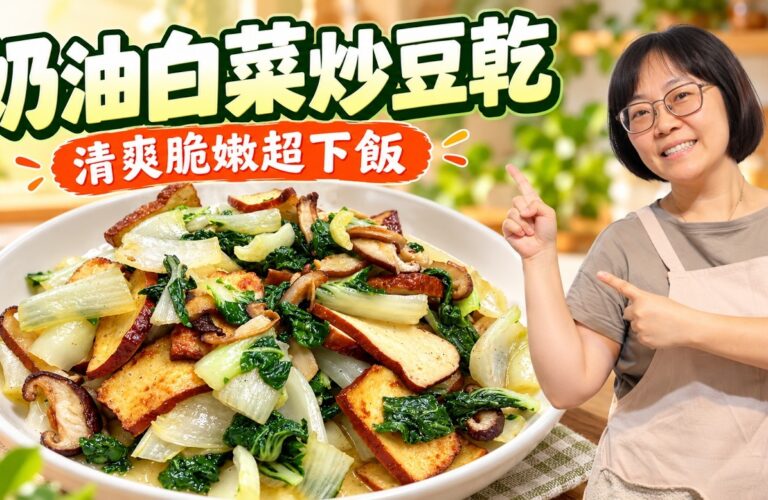
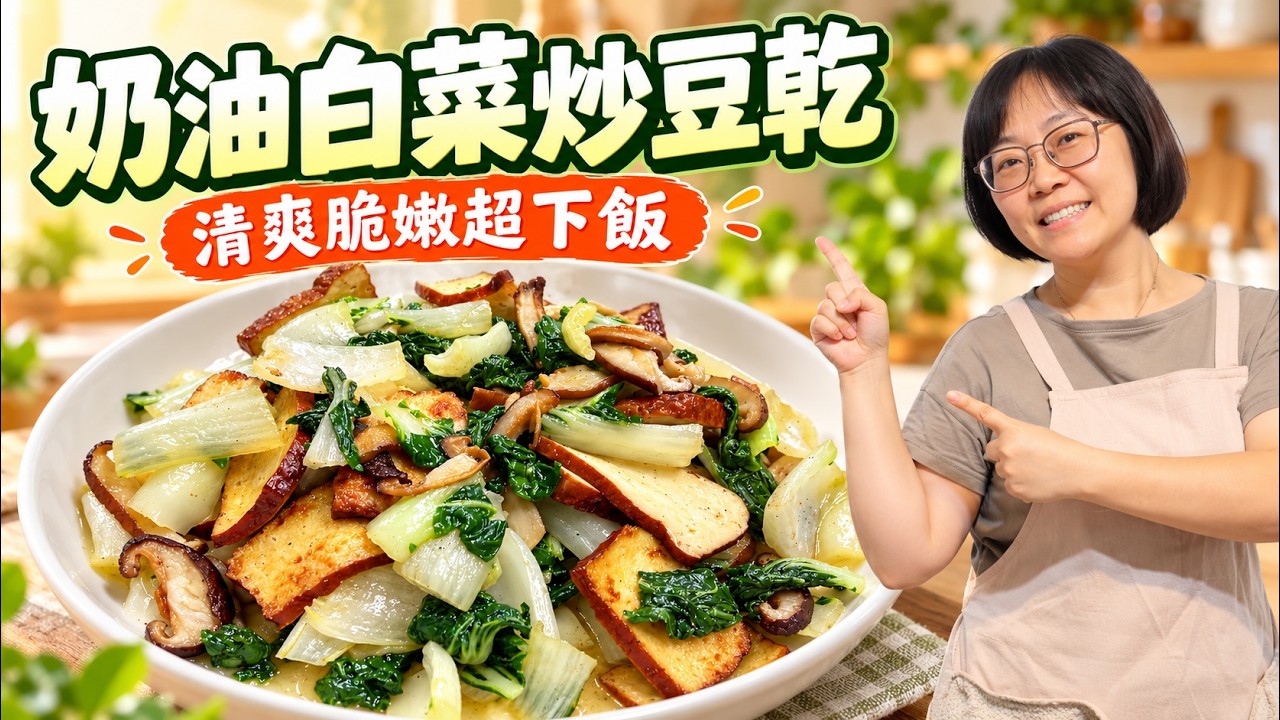
A five-minute Taiwanese home-style stir-fry where golden pan-fried dried tofu meets sweet, crisp-stemmed nai bai — all the aroma comes from shiitake mushrooms, with no scallion, garlic, or ginger anywhere near the wok. 五分鐘就能上桌的台灣家常菜:豆乾煎到金黃,配上清甜的奶油白菜,香氣全靠香菇爆香,不加蔥薑蒜也很好吃。
📹 Watch the Recipe
Recipe by 芭樂媽的家 Qistin Wong TV
🥘 Why This Recipe Works
奶油白菜炒豆乾 (nǎi yóu bái cài chǎo dòu gān) is the kind of dish that looks like nothing much and tastes like far more than the sum of its parts. The name is a small piece of Taiwanese market slang: 奶油白菜 — literally “butter cabbage” — is a pale-stemmed, tender baby bok choy cultivar prized for stems that stay sweet instead of turning bitter. There is no butter in it and no cream sauce anywhere; the name is purely a compliment about how soft and rich the vegetable eats. Paired with 豆乾 (dried tofu), it becomes one of the most common weeknight plates in a Taiwanese home kitchen.
The technique is where the flavor lives. In a Buddhist-vegetarian kitchen, 五辛 — the five pungent vegetables (garlic, onion, scallion, chives, leek) — are off the table, so the usual “garlic and scallion in hot oil” opening move has to be replaced. Qistin’s answer is 香菇 (shiitake): sliced thin and pan-fried until genuinely golden, it releases the same savory, roasted aromatics that a scallion would, with none of the sharpness. This is a classic 素 (vegetarian) kitchen move — mushrooms are the Buddhist cook’s answer to allium.
Then the dried tofu goes in, sliced from a block of pre-braised 手工嫩豆乾, and gets pan-fried until the surface blisters gold. Because it is a 滷豆乾 — already braised, already seasoned — it doesn’t need soy sauce or a long simmer; the frying simply wakes up the marinade and gives it a crisp, Q-tender skin. The nai bai follows in two passes, stems before leaves, so that both end up 軟中帶脆 — soft with a crisp bite — at the same moment. Seasoning is deliberately austere: a teaspoon of salt, a quarter teaspoon of white pepper, 50 cc of water. No soy sauce on green vegetables, ever, in this kitchen.
This version: 7 ingredients, one wok, 5 minutes.
🛒 Ingredients
| Nai bai / cream cabbage (奶油白菜) | 1 bunch (~400g) | Pale-stemmed baby bok choy cultivar; wash 3 times — the stems hold grit. Regular bok choy works too. |
| Fresh shiitake mushrooms (香菇) | 3 caps | Stems trimmed, caps cut into strips. The aroma base that replaces garlic and scallion. |
| Hand-made tender dried tofu (手工嫩豆乾) | 2 pieces (~120g) | Non-GMO if you can get it; a pre-braised 滷豆乾 brings its own seasoning. Cut into thin slices. |
| Cooking oil (食用油) | 2 tbsp | Enough to coat the wok and shallow-fry both the mushrooms and the tofu. |
| Salt (鹽) | 1 tsp | The only seasoning for the greens — keeps them clean and sweet. |
| White pepper (胡椒粉) | 1/4 tsp | Adds a gentle warmth without heat. |
| Water (水) | 50 cc | Just enough to steam the stems tender and bring everything together. |
| Optional: ginger (薑) | small knob | Skipped here — the family doesn’t care for it, and 五辛-free cooking doesn’t need it. |
👨🍳 Instructions
Step 1: Wash and separate the nai bai
- Pull the head apart leaf by leaf and rinse three times — the thick stems carry sand and field grit.
- Shake dry, then line the stems up and cut into short 4–5 cm segments. Short is better for lunch boxes and for children.
- Keep the thick stems and the leafy tops in two separate piles; the stems need a head start.
Step 2: Prep the mushrooms and tofu
- Rinse the shiitake well to flush out wood-chip debris, trim the stems, and cut the caps into thin strips.
- Slice the 手工嫩豆乾 into thin rectangles, roughly 3 mm thick.
- Have the salt, white pepper, and 50 cc of water measured and standing by — the stir-fry itself moves in seconds.
Step 3: Bloom the shiitake until golden
- Heat the oil in a wok over medium heat and add the shiitake strips.
- Pan-fry, stirring occasionally, until the mushrooms shrink down and turn golden around the edges — this is the whole aroma of the dish forming.
- You should be able to smell them clearly from a step away before you add anything else.
Step 4: Pan-fry the dried tofu
- Push the mushrooms to one side and slide the tofu slices into the oil.
- Let them sit and fry undisturbed until the undersides turn golden, then flip and fry the other side.
- Once both faces are gold, toss everything together — the tofu now smells roasted rather than plain.
Step 5: Stems first, leaves second
- Add the nai bai stems to the wok and toss to soften them for about 30 seconds.
- When the stems are roughly half-cooked, add the leafy tops and toss quickly — they only need a moment.
Step 6: Season, steam, and plate
- Sprinkle in 1 tsp salt and 1/4 tsp white pepper, then pour the 50 cc of water down the side of the wok.
- Toss fast, then let it bubble for another 30–60 seconds so the flavors merge and the stems go properly tender.
- Taste and adjust, then plate immediately — this is at its best straight from the wok.
💡 Tips & Substitutions
| No garlic or scallion in the house? | That’s the point — golden shiitake replaces both. Fry it properly golden and you won’t miss the allium. |
| Stems still crunchy / leaves already wilted? | You put them in together. Always stems first, leaves 30 seconds later — the stems are three times as thick. |
| Can’t find 奶油白菜 or 手工嫩豆乾? | Use Shanghai bok choy (上海青) instead, and a plain firm tofu block — but then add 1 tbsp soy sauce to give the tofu the flavor a braised 滷豆乾 would supply. |
| Want a little more depth? | A few drops of 素蠔油 (vegetarian oyster sauce) or 1/2 tsp mushroom seasoning in with the water, but the whole point of this dish is restraint. |
📊 Nutrition
Per serving (serves 2–3 as a side, 2 as a light main)
~150 cal · Protein: 9g · Carbs: 8g · Fat: 9g · Fiber: 3g
Ingredients
Method
- Pull the head apart leaf by leaf and rinse three times, since the thick stems hold grit. Line the stems up and cut into short 4-5 cm segments, then keep the thick stems and the leafy tops in two separate piles - the stems need a head start in the wok.
- Rinse the shiitake well to remove wood-chip debris, trim the stems and cut the caps into thin strips. Slice the dried tofu into 3 mm rectangles and measure out the salt, white pepper and 50 cc of water so everything is ready before the wok gets hot.
- Heat the oil in a wok over medium heat and add the shiitake strips. Pan-fry, stirring occasionally, until the mushrooms shrink down and turn golden around the edges - this is the entire aroma of the dish forming, standing in for garlic and scallion in an allium-free kitchen.
- Push the mushrooms to one side and slide the tofu slices into the oil. Let them fry undisturbed until the undersides turn golden, flip, and fry the other side. Once both faces are gold, toss everything together.
- Add the nai bai stems to the wok and toss to soften for about 30 seconds. When the stems are roughly half-cooked, add the leafy tops and toss quickly - they only need a moment.
- Sprinkle in 1 tsp salt and 1/4 tsp white pepper, then pour the 50 cc of water down the side of the wok. Toss fast and let it bubble for another 30-60 seconds so the flavors merge and the stems go properly tender, then plate immediately.
Notes
🌱 Why This Dish
奶油白菜 (nǎi yóu bái cài) is a naming joke that Taiwanese cooks stopped noticing long ago. 奶油 means butter or cream, but there is no dairy in the vegetable — it’s simply a pale-stemmed 小白菜 cultivar so tender and sweet that the market gave it the compliment. 白菜 itself is one of the oldest cultivated greens in China, a staple of northern winters, and this softer southern cousin became the everyday version in Taiwanese households — cheap, mild, and forgiving enough for a weeknight.
The tofu half of the dish carries the heavier cultural weight. 深坑 (Shenkeng, on the outskirts of Taipei) has been making dried tofu for generations, using its pure mountain-spring water, and the district’s 滷豆乾 — braised in soy, star anise, and rock sugar until the blocks turn dark and springy — is a recognized piece of Taiwanese food heritage. Buying a good pre-braised 豆乾, as Qistin does here, is a shortcut the tradition fully endorses: households have always leaned on the tofu maker for the braise and saved their own wok work for the finishing fry.
In Buddhist-vegetarian terms this is textbook 家常素菜 — plain, unshowy, and fully 五辛-free, which makes it shareable with practitioners who avoid alliums. Note that the entire dish is seasoned with salt and white pepper alone. That is a deliberate Taiwanese principle for green vegetables: 吃原型食材本身的味道, let the ingredient taste like itself. Greens get salt, not soy sauce, so their natural sweetness stays bright. Served alongside a heavier braised dish, it is the clean foil on the table — the plate that resets the palate rather than competing for attention.