 Dou Dou (豆豆)

Taiwanese night-market braised snacks (滷味) are one of the great meat-free pleasures of the island — and this version swaps nothing out: chewy five-spice dried tofu and juicy king oyster mushrooms soak up a star-anise and cassia braise until every pore is stained dark, with no garlic or onion anywhere. 夜市滷味的家常版——五香豆乾與杏鮑菇吸飽八角滷汁,全素無五辛,越嚼越香。
📹 Watch the Recipe
Recipe by 芭樂媽的家 Qistin Wong TV
🥘 Why This Recipe Works
滷味 (lǔwèi, “braised flavour”) is how Taiwan does the Chinese braise: a soy-and-spice broth kept at a bare simmer, ”
poured over whatever firm, porous protein you like. Dried tofu (豆乾, dòugān) is the classic pick — not because it is cheap, ”
but because pressing and drying tofu leaves it full of tiny channels that a good braise can climb into. Cut it as a slab and ”
only the surface takes colour; cut it into triangles and every bite meets the sauce.
Five-spice dried tofu (五香豆乾) is already seasoned before it reaches the pot, so this dish needs no aromatics beyond the ”
classic trinity of 滷水: star anise, cassia bark and bay leaf. That combination is what 五香 (“five spice”) really means in ”
practice — warm, sweet-woody and faintly resinous, not hot. King oyster mushrooms are the perfect partner because they behave ”
like a natural sponge: roll-cut them into chunks and they flood with braise, sometimes outshining the tofu itself. Because ”
nothing here is garlic, scallion or onion, the whole pot is 五辛-free (allium-free) and fully Buddhist-vegetarian.
This version: 9 ingredients, one pot, 15 minutes of hands-on work (plus a slow braise and soak).
🛒 Ingredients
| Five-spice dried tofu (五香豆乾) | 8 slices, ~300 g | Buy the thin kind — they soak faster. Cut into triangles. |
| King oyster mushrooms (杏鮑菇) | 2 large, ~150 g | Roll-cut into chunks, not too small — they shrink in the braise. |
| Water (清水) | 500 cc | The braise base. |
| Soy sauce (醬油) | 80 cc | Your only salt. Regular, not dark, so it does not go bitter. |
| Star anise (八角) | 3 whole | The backbone of the aroma. |
| Cassia bark (桂皮) | 2 pieces | Cinnamon-adjacent; adds warm sweetness. |
| Bay leaves (月桂葉) | 2 | Floral, slightly herbal lift. |
| Toasted sesame oil (香油) | ~1 tbsp | Adds aroma and makes the finished tofu slide instead of squeak. |
| Black pepper (黑胡椒) | ~1/2 tsp | A touch of background heat. |
| Optional add-ins (滷味配料) | To taste | Kelp (海帶), tofu skin / hundred-layer tofu (百葉豆腐), wheat gluten rolls (麵腸) — anything that braises well. |
👨🍳 Instructions
Step 1: Cut the tofu into triangles
- Use thin five-spice dried tofu — roughly 8 slices, about 300 g — and cut each slice on the diagonal into triangles.
- Triangles give you a bigger cut face than rectangles, so the braise has far more surface to enter.
- Leave them triangle-sized for now; cut them smaller after braising if you want one-bite pieces for kids.
Step 2: Prep the mushrooms
- Roll-cut (滾刀) 2 king oyster mushrooms into chunky blocks — bigger than bite-sized, because they shrink a lot during an hour of braising.
- Keep the caps and stems together; both soak up sauce.
- If your household loves mushrooms, add a third — they disappear first.
Step 3: Build and bloom the braise
- Bring 500 cc of water to a boil, then add 80 cc soy sauce, 3 star anise, 2 pieces of cassia bark and 2 bay leaves.
- Add a splash of toasted sesame oil and a scatter of black pepper.
- Let it boil for 1–2 minutes before the tofu goes in — that short boil is what releases the aroma from the whole spices.
Step 4: Braise low and slow, turning every 15 minutes
- Slide in the tofu triangles and mushrooms, then add water if needed so everything is nearly covered.
- Lid on, drop to the lowest simmer, and braise for 1 hour. The surface should tremble, never roll.
- Every ~15 minutes, lift the lid and turn the pieces so they colour evenly.
- If you want to taste for seasoning mid-way, taste the broth, not the tofu — the tofu is still absorbing and will read too bland.
Step 5: Kill the heat and let it soak (the real secret)
- When the hour is up, switch off the heat and leave the pot covered for about 2 hours.
- Off-heat soaking is what drives the sauce all the way through the tofu’s honeycomb interior instead of leaving a bland centre.
- It will look ready after an hour of simmering; it only becomes truly 入味 after the soak.
Step 6: Chill and serve
- Let the pot cool, then refrigerate the tofu and mushrooms in their braise — cold, it firms up and tastes even deeper.
- Serve chilled as a side, at room temperature as a bento filler, or warmed over rice.
- Keep submerged in the braise in a sealed container; it keeps about 4–5 days and improves for the first two.
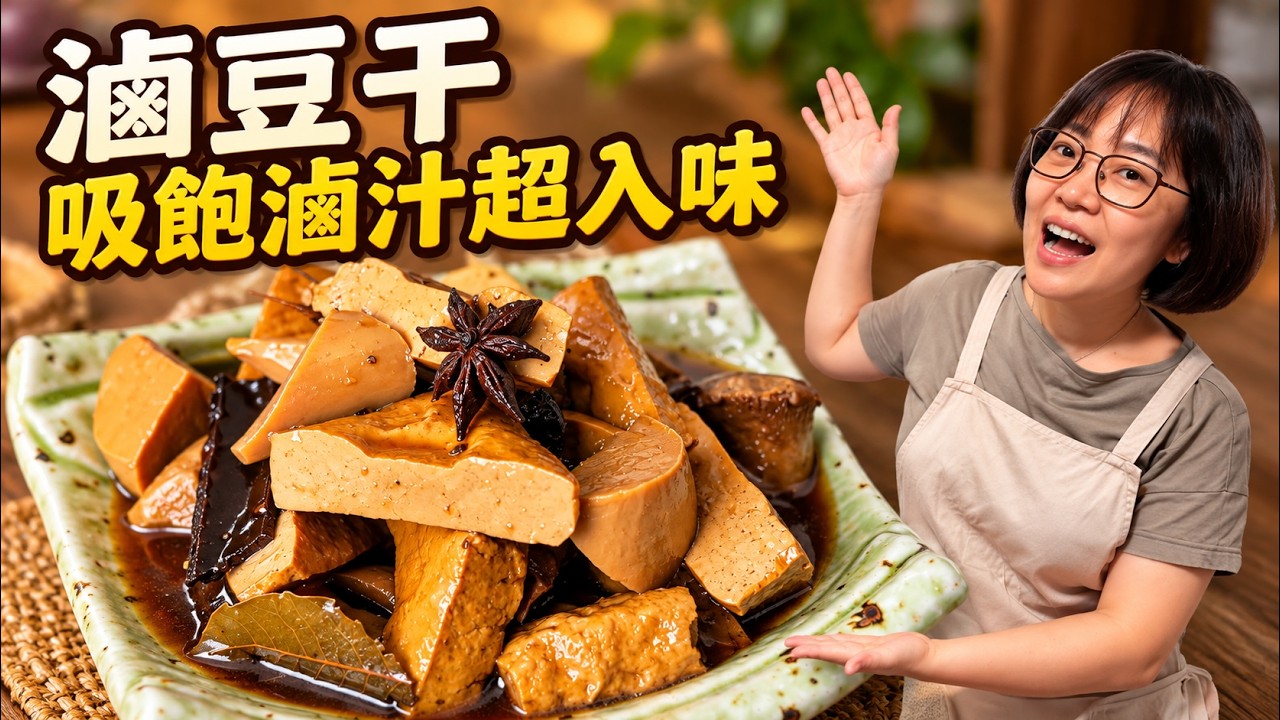
Braised Five-Spice Tofu with King Oyster Mushrooms (滷豆乾杏鮑菇)
Ingredients
Method
- Cut 8 slices of thin five-spice dried tofu on the diagonal into triangles. The bigger cut face lets far more braise soak in.
- Roll-cut 2 king oyster mushrooms into chunky blocks — not too small, since they shrink a lot. A third one never hurts; they go first.
- Boil 500 cc water with 80 cc soy sauce, 3 star anise, 2 pieces cassia bark, 2 bay leaves, a splash of sesame oil and a scatter of black pepper. Let it boil 1–2 minutes so the whole spices release their aroma before the tofu goes in.
- Add the tofu and mushrooms, lid on, lowest simmer, 1 hour. Lift the lid every ~15 minutes and turn the pieces so they colour evenly. Taste the broth — not the tofu — if you want to check seasoning.
- Turn off the heat and leave the pot covered about 2 hours. This off-heat soak is what drives the sauce through the tofu's honeycomb interior.
- Cool, then refrigerate the tofu and mushrooms in their braise. Serve chilled as a side, at room temperature as a bento filler, or warmed over rice. Keeps 4–5 days submerged in the braise.
Notes
💡 Tips & Substitutions
| The tofu tastes good on the outside but bland in the middle | Cut it into triangles (more cut surface), braise the full hour, and do not skip the 2-hour off-heat soak. |
| The braise smells flat | Boil the soy-and-spice liquid 1–2 minutes before adding the tofu, so the star anise and cassia actually bloom. |
| Braise reduces too far or scorches | Keep it at the lowest simmer with the lid on and turn every 15 minutes; top up with hot water if the level drops below half. |
| How do I know it is done? | Cut one open — the interior should be stained dark, not white. If it is still pale, add 15 minutes of simmering plus another soak. |
| Can I use regular tofu? | Firm or extra-firm tofu works but absorbs far less; pressed tofu or frozen-then-thawed tofu gets you closer to the porous texture of dried tofu. |
| Want it spicier? | Add 2–3 dried chillies to the braise, or a teaspoon of chilli oil at the end. Keep the star anise and cassia in — they carry the dish. |
📊 Nutrition
Per serving (serves 4 as a side or bento filler)
~185 cal · Protein: 13g · Carbs: 11g · Fat: 9g · Fiber: 3g
🌱 Why This Dish
滷 (lǔ) originally meant to simmer something in a spiced soy brine; in Taiwan it became an entire genre — 滷味 — sold by the bag at ”
night markets, where you point at what you want and it comes back chopped, drizzled with braise and dusted with white pepper. ”
For anyone eating meatless, 豆乾 (dried tofu) is the anchor of that bag: the densest, chewiest form of tofu, and the one that ”
actually rewards being cooked twice — once in the pot, once in the cooling liquid.
The Buddhist-vegetarian logic behind this recipe is in what is missing. Chinese monastic cooking avoids 五辛 (wǔ xīn) — ”
garlic, scallion, onion, chives and leek — because these are held to agitate the senses and cloud meditation. Where a home cook ”
would reach for garlic and scallion, temples and 全素 kitchens reach for the warm spices instead: 八角 (star anise), 桂皮 (cassia) ”
and 月桂葉 (bay). That is why a well-made 滷水 tastes round and slightly sweet rather than sharp, and why it works just as well ”
cold from the fridge as it does hot from the pot.
Dried tofu itself has long been the protein backbone of vegetarian temple kitchens and 便當 (bento) culture across Taiwan and ”
Malaysia — cheap, shelf-stable, and able to carry whatever flavour it is given. This is a house 家常菜 version of a night-market ”
food: one pot, no frying, and a pot that tastes better the next day.