 Dou Dou (豆豆)
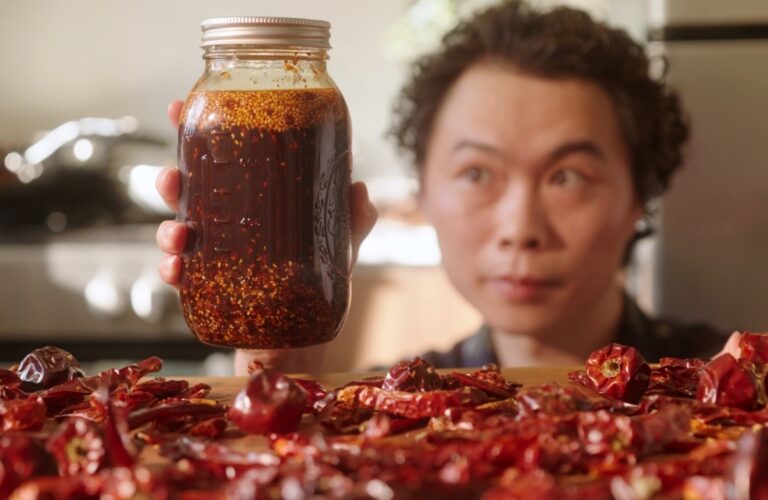
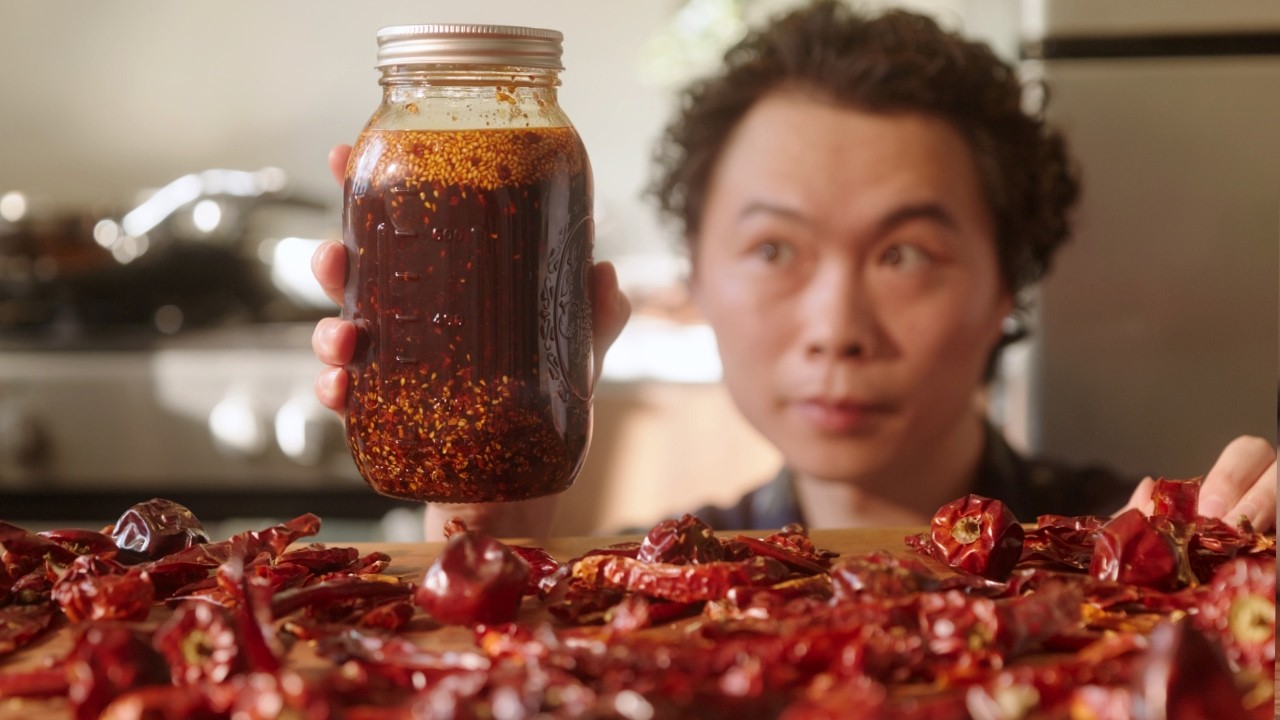
Real Sichuan chili oil is not one chili and one pour of oil — it is three chilies, two pours at two different temperatures, and one night of patience, and it works in an ordinary kitchen with an oven instead of a wok. 做四川红油的关键不在辣,而在三种辣椒的配比和两次不同油温的泼法:不用炒锅,用烤箱也能做出色、香、味俱全的家常红油。
📹 Watch the Recipe
Recipe by Lionel Zeng
🥘 Why This Recipe Works
In most Sichuan kitchens there is no such thing as running out of chili oil. The jar gets refilled before it is ever empty, the way a Western kitchen never runs out of salt. 红油 (hóng yóu) is the backbone of the whole cold-dish and noodle repertoire — spooned over 凉拌菜 cold salads, stirred into 担担面 dan dan noodles, pooled around 红油抄手 wontons, ladled over plain 豆花 tofu pudding. Few things in Chinese cooking return as much flavour for as little effort as a good jar of it.
So why does homemade chili oil so often taste flat? The answer in this video is simple: most people use one kind of chili and pour the oil once. Real Sichuan chili oil uses three chilies, each doing a different job. 二荆条 (èr jīng tiáo), the classic Sichuan chili, is mild and carries the colour and fragrance — nutty and faintly smoky. 灯笼椒 (dēng lóng jiāo, “lantern chili”) from Guizhou is barely spicy at all; it is there for a sweet, fruity aroma and its shape, which really does look like a paper lantern. 七星椒 (qī xīng jiāo, “seven-star chili”) is the heat dial: 10 g is mild, 30 g is medium, 50 g is genuinely hot. The chilies are toasted in a 300°F oven rather than a wok — 15 minutes, a shake, 10 minutes cooling, then 10 more — until each one is a shade darker and shatters when you squeeze it.
Then come the two details that decide everything. First, the grind: about two-thirds of the toasted chilies become medium-coarse flakes and the last third is pounded to a fine powder, so the finished oil has both body and grit. Second, the golden ratio and the two pours — one part ground chili to five parts oil, by weight. Roughly a third of the oil goes over the chili at 375°F (190°C) for aroma, and the rest follows at 285°F (140°C) for that bright, almost luminous red. Sesame seeds and a little rock sugar go in at 210°F. Everything else — star anise, cassia, sand ginger, black cardamom, fennel, ginger, onion and cilantro — is only there to perfume the oil before it ever meets the chili.
3 chilies, 6 spices, 2 pours of oil — about 20 minutes of hands-on work and one night of waiting. No wok required, and fully vegan.
🛒 Ingredients
| Er jing tiao chilies (二荆条) | 100 g | Mild Sichuan chili — the colour and fragrance backbone. Nutty, lightly smoky |
| Lantern chilies (灯笼椒) | 100 g | From Guizhou. Almost no heat; gives a sweet, fruity aroma |
| Seven-star chilies (七星椒) | 10–50 g | Your heat dial: 10 g mild, 30 g medium, 50 g hot |
| Neutral oil (菜籽油/食用油) | about 4½ cups (~1 litre) | Canola is traditional in Sichuan; any neutral oil works. Weigh the ground chili and multiply by 5 |
| Star anise (八角) | 3 pieces | Dry spice — soaked before frying |
| Cassia bark (桂皮) | 1 piece | Snap in half. Warm, sweet-barky depth |
| Sand ginger (山柰) | 3 small pieces | Resinous and slightly camphor-like — the Sichuan signature note |
| Bay leaves (香叶) | 5 leaves | |
| Black cardamom (草果) | 2 pods | Crush lightly and remove the seeds — smoky, medicinal |
| Fennel seeds (小茴香) | ½ tsp | Sweet anise edge |
| Warm water (温水) | ½ cup | For soaking the dry spices so they release flavour without scorching |
| Ginger (姜) | 2 pieces, sliced | Fresh aromatics |
| Chinese long onion (大葱) | 1, white part only | Cut into chunks — do not use the green tops |
| Onion (洋葱) | ½, sliced | |
| Scallions (小葱) | 5 stalks | Cut into 3-inch lengths |
| Cilantro (香菜) | a small handful | Stems and all |
| Toasted white sesame seeds (白芝麻) | 3 tbsp | Stirred in at the end |
| Rock sugar (冰糖) | 3 small pieces, crushed | Rounds off the heat and sharpens the colour |
👨🍳 Instructions
Step 1: Rinse, dry and oven-toast the three chilies
- Give the dried chilies a quick rinse — Chinese dried chilies are usually air-dried outdoors and carry dust. Shake them dry and spread them in a single layer on a sheet pan to dry further while the oven heats.
- Use 100 g of 二荆条, 100 g of 灯笼椒, and then 七星椒 to taste: 10 g for mild, 30 g for medium, 50 g if you want it properly hot.
- Roast at 300°F / 150°C for 15 minutes. Pull the pan out, shake it to turn the chilies, and let them cool for 10 minutes so the moisture inside evens out.
- Return them to the oven for another 10 minutes at the same temperature, until everything is one shade darker. Take them out, shake again and let them cool completely — they crisp up as they cool.
- Squeeze test: a chili should shatter easily between your fingers. If it still bends, put it back in the oven for 5 more minutes.
Step 2: Snap, de-seed and grind two textures
- Snap the 二荆条 and 七星椒 into short pieces by hand and tear or cut the lantern chilies in half.
- Shake most of the seeds out — too many seeds make a gritty, muddy oil — but keep a small pinch back for their nutty aroma.
- Pound the chilies in a mortar and pestle (the traditional way, which releases more essential oil) or pulse them in a food processor. Do not blend to dust.
- Grind about two-thirds of the batch to medium-coarse flakes and the remaining third to a fine powder. Those two textures are what give the finished oil layers.
Step 3: Weigh the blend and split it between two bowls
- Weigh the ground chili blend and multiply by five — that is exactly how much oil you need. The golden ratio is one part chili to five parts oil, by weight.
- Starting from the video’s 250 g of chilies and allowing for the seeds you shook out, that works out at about 4½ cups (roughly 1 litre) of oil.
- Divide the ground chili evenly between two bowls. Bowl one must be the big one, because everything ends up in it.
Step 4: Soak the dry spices, prep the fresh aromatics
- Soak 3 star anise, 1 piece of cassia snapped in half, 3 small pieces of sand ginger, 5 bay leaves, 2 black cardamoms with the seeds removed, and ½ tsp fennel seeds in ½ cup of warm water.
- The soak hydrates the spices so they give up their flavour in the oil without scorching — this is why the finished oil tastes layered rather than burnt.
- Meanwhile slice 2 pieces of ginger, cut the white part of 1 Chinese long onion into chunks, slice ½ onion, and cut 5 scallions plus a small handful of cilantro into 3-inch lengths. Keep all the fresh aromatics together.
Step 5: Infuse the oil, then strain out every solid
- Heat the measured oil in a heavy pot over medium-low heat and add all the fresh aromatics. Let them fry gently — high heat only burns them and turns the oil bitter.
- Once they start browning, add the drained dry spices and cook for about 2 more minutes, until the spices look dry and the aroma is deep and warm.
- Strain the oil clear of every solid part into a clean, dry pot or bowl. Nothing solid should stay behind to keep cooking.
Step 6: Two pours at two temperatures
- Bring the strained oil to 375°F / 190°C. Ladle just enough over the chili in bowl one to cover it, stirring fast and hard the whole time. This is the aroma layer — the chilies darken and smell roasty.
- Let the oil in the pot fall to 285°F / 140°C. Tip the contents of bowl two into bowl one, stir once, then immediately pour in all the remaining oil while stirring. This is the colour layer, and this is where the bright red comes back.
- When the mixture has cooled to about 210°F / 100°C, stir in 3 tbsp of toasted white sesame seeds and 3 small pieces of crushed rock sugar. The sugar rounds the heat off slightly.
Step 7: Rest overnight, jar it, keep it cold
- Cover the bowl loosely and leave it at room temperature overnight — about 12 hours. The chilies keep giving colour and aroma the whole time.
- Stir, then transfer to clean jars and store in the fridge, where it will keep for at least a few months.
- Stir before each use, since the chili settles. Spoon it over noodles, dumplings, blanched vegetables, tofu or rice.
💡 Tips & Substitutions
| My chili oil tastes flat or muddy | You poured once, at one temperature. The two pours are the entire fix: 375°F for aroma, 285°F for colour. Dump everything in at 375°F and the chili goes dark and bitter; wait too long and pour at 250°F and you get colour with no fragrance. |
| It came out too spicy | Dial down the 七星椒 only: 10 g mild, 30 g medium, 50 g hot. Never cut the 二荆条 or lantern chilies — they carry the colour and aroma, not the heat. |
| I can’t find three kinds of dried chili | Keep the mild aromatic chili (二荆条 or similar) as your base. For lantern chilies, use a mild sweet dried chili or paprika-type chili and add a pinch more sugar. For 七星椒, any hot dried chili such as bird’s eye works — a little goes a long way. |
| No wok, no mortar and pestle | Neither is required. The oven does the wok’s job in Step 1, and a food processor handles the grind — pulse it and stop while flakes remain. Pounding is traditional and arguably releases more oil, but the difference is small. |
| The spices taste burnt | They went in too early or the oil was too hot. Always soak them first, add them only after the aromatics have browned, and pull every solid out as soon as the spices look dry. |
📊 Nutrition
Per serving (1 tbsp; the recipe makes about 4½ cups / 72 tbsp)
~125 cal · Protein: 0 g · Carbs: 1 g · Fat: 14 g · Sodium: 0 mg (no salt added)
Ingredients
Method
- Rinse the dried chilies quickly (they are air-dried outdoors and dusty) and spread them in a single layer on a sheet pan to dry while the oven heats. Use 100 g er jing tiao, 100 g lantern chilies, plus 10-50 g seven-star chilies depending on how hot you want it. Roast at 300F / 150C for 15 minutes, pull the pan out, shake it, and let them cool for 10 minutes. Return to the oven for 10 more minutes at the same temperature until everything is one shade darker, then shake again and let them cool completely. A chili should shatter easily when squeezed; if it still bends, give it 5 more minutes.
- Snap the er jing tiao and seven-star chilies into short pieces by hand and tear the lantern chilies in half. Shake most of the seeds out (too many make a gritty oil) but keep a small pinch back for their nutty aroma. Pound in a mortar and pestle, or pulse in a food processor - do not blend to dust. Grind about two-thirds to medium-coarse flakes and the last third to a fine powder for layers of texture.
- Weigh the ground chili blend and multiply by five - that is exactly how much oil you need. The golden ratio is one part chili to five parts oil, by weight, which for the video's 250 g of chilies works out at about 4 1/2 cups (roughly 1 litre). Divide the ground chili evenly between two bowls, making bowl one the large one since everything ends up in it.
- Soak 3 star anise, 1 piece of cassia snapped in half, 3 small pieces of sand ginger, 5 bay leaves, 2 black cardamoms with the seeds removed, and 1/2 tsp fennel seeds in 1/2 cup of warm water. This hydrates them so they release flavour without scorching. Meanwhile slice 2 pieces of ginger, cut the white part of 1 Chinese long onion into chunks, slice 1/2 onion, and cut 5 scallions plus a small handful of cilantro into 3-inch lengths.
- Heat the measured oil in a heavy pot over medium-low heat and add all the fresh aromatics; let them fry gently, because high heat only burns them. Once they start browning, add the drained dry spices and cook about 2 more minutes until the spices look dry and the aroma is deep. Strain the oil clear of every solid part into a clean, dry pot - nothing should stay behind to keep cooking.
- Bring the strained oil to 375F / 190C. Ladle just enough over the chili in bowl one to cover it, stirring fast and hard the whole time - this is the aroma layer, and the chilies darken and smell roasty. Let the oil in the pot fall to 285F / 140C, tip the contents of bowl two into bowl one, stir once, then immediately pour in all the remaining oil while stirring - this is the colour layer, where the bright red comes back. When the mixture cools to about 210F / 100C, stir in 3 tbsp toasted white sesame seeds and 3 small pieces of crushed rock sugar.
- Cover the bowl loosely and leave it at room temperature overnight, about 12 hours, so the chilies keep giving colour and aroma. Stir, then transfer to clean jars and store in the fridge, where it keeps for at least a few months. Stir before each use, as the chili settles.
Notes
🌱 Why This Dish
红油 (hóng yóu), literally “red oil”, is what Sichuan cooks call this condiment; 辣椒油 (là jiāo yóu), “chili oil”, is the plainer Mandarin name you will see printed on jars. The word 红 — red — is the point. Sichuan cooking judges a dish on 色、香、味: colour, aroma, taste, in that order. Chili oil is where all three are built at once, which is why it is treated as a pantry foundation rather than a sauce you make once for one dish.
The chilies themselves are a geography lesson. 二荆条 is the signature chili of Sichuan, grown around the Chengdu plain, and it is the same variety that gives 郫县豆瓣 (Pixian doubanjiang) its deep red colour and its fragrance rather than raw heat. 灯笼椒, the lantern chili, is named for its shape — it opens like a paper lantern, and it was bred for aroma rather than fire. 七星椒, “seven-star chili”, takes its name from its heat rating and comes from Guizhou, as does the lantern chili; Sichuan has always cooked with chilies from its southern neighbour. The aromatic cast around them — 八角 star anise, 桂皮 cassia, 草果 black cardamom, 山柰 sand ginger, 小茴香 fennel — is the same warm spice family used in 卤味 braises and 火锅 hotpot bases, borrowed here to perfume the oil rather than to season a broth.
For anyone cooking without meat, chili oil earns its place many times over. The dishes a jar of 红油 unlocks are exactly the cheap, plant-based ones: blanched greens and 白水菜 boiled vegetables, cold 凉拌 cucumber or wood ear, plain tofu or 豆花, a bowl of noodles with nothing but soy sauce and a spoon of red oil. A spoonful turns a handful of vegetables into something that tastes restaurant-made, which is precisely why the jar is never allowed to run empty.
The whole process here is 全素 — fully vegan, no animal product at any stage. It is not, however, 五辛-free in the strict Buddhist sense: onion, scallion and Chinese long onion are all part of the aromatic infusion, and those are among the five pungent vegetables many Buddhist kitchens avoid. A temple version simply drops them, leaning harder on ginger and the dry spices, and it works beautifully — the spices were always carrying most of the aroma. Either way, the finished oil keeps for months in the fridge, which makes it the kind of thing worth making in one long evening and eating from all winter.