 Dou Dou (豆豆)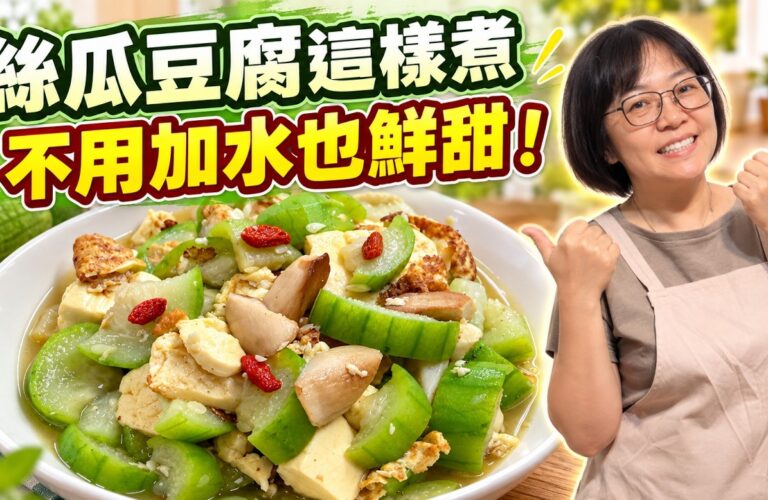
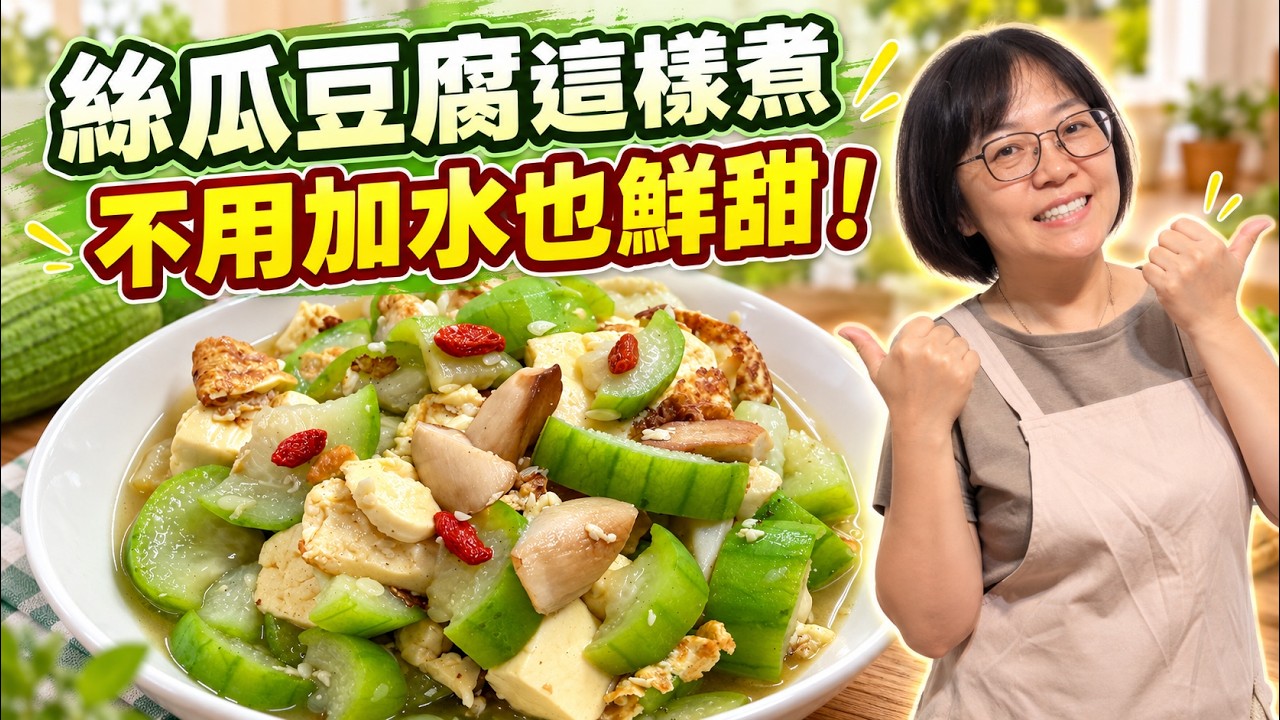
A sweet, tender luffa gourd braised with golden silken tofu and chewy king oyster mushroom — a classic Taiwanese home dish that cooks in its own juices, no water needed. 絲瓜與嫩豆腐一同燜煮,天然的清甜湯汁讓這道無水家常菜鮮香入味,簡單卻叫人一碗接一碗。
📹 Watch the Recipe
Recipe by 芭樂媽的家 Qistin Wong TV
🥘 Why This Recipe Works
絲瓜 (sī guā), the luffa or sponge gourd — known affectionately in Taiwan as 菜瓜 — is one of the great summer vegetables of southern China. Prized for its delicate sweetness and its cooling (清涼) nature in Chinese food therapy, it needs almost nothing done to it to taste good. Here it stars in a 無水料理 (“waterless cooking”) technique: braised under a lid, the gourd releases so much of its own moisture that the pan makes its own broth.
The dish pairs luffa with two quiet partners. Silken tofu softens into creamy, egg-like curds that soak up the sweet broth, while a single king oyster mushroom adds a bouncy, QQ chew so the dish isn’t all softness. A short braise lets everything exchange flavors without any heavy sauce — just salt and a whisper of white pepper.
This version: 4 ingredients, one pan, 15 minutes.
🛒 Ingredients
| Luffa gourd (絲瓜) | 1 (about 450g) | Pick a firm, heavy one — avoid the cheapest, they turn fibrous |
| Silken tofu (嫩豆腐) | 1 box (about 350g) | Firm tofu (板豆腐) also works — pan-fry it first to set |
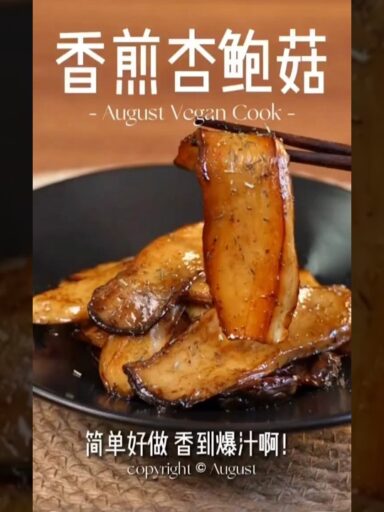
| King oyster mushroom (杏鮑菇) | 1 large | Roll-cut into chunks for a QQ bite |
| Goji berries (枸杞) | Small handful | Optional, added at the end for a pop of red |
| Cooking oil (食用油) | 1 tbsp | For pan-frying |
| Salt (鹽) | 1 tsp | Adjust to taste |
| White pepper (胡椒粉) | ½ tsp | Keeps the dish light and clean-tasting |
| Water (水) | A splash | Only if the luffa is dry — usually not needed |
👨🍳 Instructions
Step 1: Peel and Slice the Luffa
- Keep your peeler light — shave off only the coarse ridged skin and leave a thin layer of green beneath. The green keeps the finished dish vivid.
- Halve the luffa lengthwise, trim any bruised spots, then slice into thin rounds (about 3mm).
- Thin slices cook fast and stay tender; thick ones turn spongy.
Step 2: Cut the Mushroom and Tofu
- Roll-cut the king oyster mushroom (滾刀) into 3 chunky pieces so it holds a satisfying chew.
- Cut the silken tofu into small cubes along its natural grid. Squeeze the box to slide it out; if it crumbles, don’t worry — the curds mimic scrambled egg.
Step 3: Pan-Fry Until Golden
- Heat the oil in a pan over medium-high. Add the mushroom and fry until the edges are golden.
- Add the tofu alongside and let it set and brown on one face before flipping — about 4–5 minutes total.
Step 4: Add the Luffa and Braise
- Push the mushroom and tofu to the edges, add the luffa, then cover with a lid and braise for 2 minutes.
- The luffa will soften and release its own water — this is the waterless trick. Only splash in water if the pan looks dry.
Step 5: Season and Finish
- Add the salt and white pepper, toss gently, and braise on low for about 3 more minutes until the luffa is fully tender.
- Scatter in the goji berries, cook 1 minute more for color, then turn off the heat and plate immediately — the luffa’s skin can yellow if overcooked.
💡 Tips & Substitutions
| Can I use firm tofu instead of silken? | Yes — use 板豆腐. Pan-fry it first so it holds its shape instead of crumbling. The silken version melts into soft, egg-like curds, which is part of the dish’s charm. |
| The dish looks watery. | That’s expected. Luffa and silken tofu both release water, which becomes the sweet broth — don’t add more. Spoon it over steamed rice. |
| How do I avoid a fibrous luffa? | Buy a firm, heavy gourd and skip the cheapest ones — cheap luffa is usually over-mature and spongy like a loofah. Peel thin, and slice before it hardens. |
| How do I make it a one-pot meal? | Once the luffa is tender, add extra water and a bundle of thin wheat noodles (麵線) — you get 絲瓜豆腐麵線, a warm one-pot noodle soup. |
📊 Nutrition
Per serving (serves 2 as a main with rice)
~150 cal · Protein: 10g · Carbs: 9g · Fat: 9g · Fiber: 3g
Ingredients
Method
- Peel the luffa with a light hand, shaving off only the coarse ridged skin and leaving a thin layer of green. Halve lengthwise, trim any bruised spots, then slice into thin rounds about 3mm thick.
- Roll-cut the king oyster mushroom into 3 chunky pieces. Cut the silken tofu into small cubes along its grid; if it crumbles, that's fine — the curds mimic scrambled egg.
- Heat the oil over medium-high. Fry the mushroom until the edges are golden, then add the tofu alongside and brown one face before flipping — about 4 to 5 minutes total.
- Push the mushroom and tofu to the edges, add the luffa, cover, and braise 2 minutes. The luffa releases its own water — only add a splash if the pan looks dry.
- Add the salt and white pepper, toss gently, and braise on low about 3 minutes until tender. Scatter in the goji berries, cook 1 minute more, then turn off the heat and plate.
Notes
🌱 Why This Dish
絲瓜 (sī guā), the luffa or sponge gourd, is one of the most loved summer vegetables in southern China and Taiwan, where it’s fondly called 菜瓜. In traditional Chinese food therapy it’s considered cooling (清涼), the ideal vegetable for sweltering weather. Luffa and tofu is a classic pairing — the sweet, tender gourd against the mild, creamy bean curd.
In Buddhist temple kitchens (素菜, sù cài), dishes like this embody the spirit of 無水料理 — cooking without added water, letting seasonal vegetables carry the flavor. It’s a staple of 家常菜 (home-style cooking): eaten with steamed rice on an ordinary weeknight, and turned into a one-pot noodle soup when the family wants something warmer. It’s proof that meatless cooking doesn’t need mock meat — good vegetables and simple seasoning are enough.