 Dou Dou (豆豆)

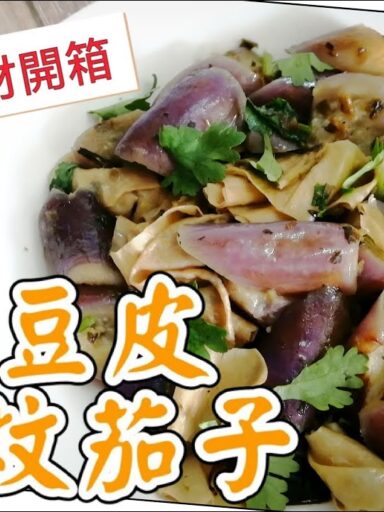
Silky eggplant and chewy dried tofu come together in a sauce that clings to every strip — the kind of dish that quietly empties a rice cooker. 茄子軟糯吸汁、豆乾鹹香有嚼勁,這道家常下飯菜一上桌,白飯立刻見底。
📹 Watch the Recipe
Recipe by 芭樂媽的家 Qistin Wong TV
🥘 Why This Recipe Works
Most home cooks avoid eggplant because it drinks oil like a sponge and turns to gray mush in the pan. This Taiwanese home-style method (豆乾炒茄子, dòu gān chǎo qié zi) solves both problems with one clever trick: scoring. The eggplant is halved, two chopsticks are laid on either side as depth guards, and the flesh is cut into a fine ladder of grooves. Those grooves do two jobs at once — they let the sauce penetrate to the center of every piece, and they keep the eggplant from collapsing into a single shapeless mass.
Then comes the waterless technique. Instead of deep-frying, the scored eggplant is tossed in a little oil, partly covered with water, and steamed under a lid for exactly four minutes. It comes out tender, glossy, and barely greasy. Once it leaves the pan, no more liquid is added at any point. That single rule is why the finished dish tastes so concentrated: every drop of sauce has nowhere to go but onto the tofu and eggplant.
The flavor comes from three layers — pan-fried dried tofu (豆乾) for chew and protein, a spoonful of Taiwanese Hai Shan sauce (海山醬) for a sweet-savory edge that is far milder than it sounds, and a fistful of Thai basil (九層塔) thrown in at the very end so its perfume stays intact. If you only know eggplant as oily and bland, this is the dish that will change your mind.
This version: 8 ingredients, one pan, 20 minutes.
🛒 Ingredients
| Eggplant (茄子) | 1 large, about 300 g | The long thin Asian variety — thinner skin, fewer seeds, holds its shape far better than the fat globe kind |
| Dried tofu (豆乾) | 2 pieces, about 80 g | Pressed five-spice tofu; slice it thin so it can crisp at the edges |
| Red bell pepper (紅甜椒) | ½ pepper | Sliced into thin strips; adds sweetness and the color contrast that makes the plate look alive |
| Thai basil (九層塔) | 1 generous handful | The signature herb of Taiwanese cooking — added off the heat so it stays fragrant, never bitter |
| Hai Shan sauce (海山醬) | 1 tbsp | Taiwanese sweet chili-style sauce. Sweet and rounded rather than spicy, so kids eat it happily |
| Light soy sauce (醬油) | 1 tbsp | Adds the salt and the deep amber color |
| Neutral oil (食用油) | 2 tbsp, split | Any neutral oil; half for the eggplant, half for frying the tofu |
| Water (清水) | about 150 ml | Just enough to reach halfway up the eggplant for the covered braise |
| Optional: vegan meatball (丸子) | 1, sliced thin | Classic fridge-clearing addition; skip or swap for extra tofu |
| Optional: fresh red chili (辣椒) | to taste | Slice into thin rings if you want a gentle warmth under the sweetness |
👨🍳 Instructions
Step 1: Score the eggplant
- Trim the stem end, then cut the eggplant in half lengthwise.
- Lay two chopsticks along the sides of each half — they act as depth guards so the knife never cuts through.
- Cut fine vertical grooves down the flesh, then repeat on a slight angle to create a crosshatch ladder.
- Slice the scored halves into short, bite-sized segments. This is the only fiddly part of the whole recipe, and it takes about two minutes.
Step 2: Steam-braise the eggplant
- Heat 1 tbsp oil in a wide pan or wok over medium-high heat, then add the eggplant and toss quickly so every surface is coated — the oil film is what stops it from browning.
- Pour in water to about halfway up the eggplant, cover with a lid, and cook for 4 minutes.
- Lift out the eggplant with a slotted spoon and discard the cooking water. It has done its job and would only dilute the sauce later.
Step 3: Fry the dried tofu
- Add the remaining tablespoon of oil to the same pan and lay in the sliced dried tofu (plus the sliced vegan meatball, if using).
- Fry, turning, until the edges turn light golden — roughly 2 minutes. The Maillard browning here is what gives the dish its savory backbone.
Step 4: Build the sauce in the pan
- Drop in the red bell pepper strips and the chili, if using, and stir for about 30 seconds.
- Add 1 tbsp Hai Shan sauce and 1 tbsp soy sauce directly into the pan and stir to coat everything evenly.
- Keep the heat high — the sauces should sizzle and thicken slightly, not simmer.
Step 5: Return the eggplant for a waterless finish
- Slide the eggplant back in and toss gently for 40–60 seconds, just long enough for the grooves to soak up the sauce.
- Do not add any water at this stage — this is the rule that keeps the flavor concentrated.
- Turn off the heat, add the Thai basil, and toss once using the residual heat until the leaves just wilt and release their aroma.
Step 6: Plate and serve
- Slide onto a warm plate and serve immediately with steamed white rice.
- Spoon the pan juices over the top — the sauce left behind is the best part.
💡 Tips & Substitutions
| My eggplant always turns oily and mushy | Two fixes: coat it with oil before any liquid touches the pan, and keep the covered braise to 4 minutes. Longer than that and the flesh disintegrates. |
| I can’t find Hai Shan sauce | Mix 1 tbsp hoisin sauce with ½ tsp sugar and a splash of rice vinegar — close enough in sweetness and body. Sweet chili sauce also works in a pinch. |
| The dried tofu tastes dry and hard | Slice it as thinly as you can (about 3 mm) so it fries quickly, and give it a 5-minute soak in warm water first if it feels leathery. Five-spice pressed tofu is the most forgiving type. |
| No Thai basil in my area? | Regular Italian basil will do in a pinch, or use celery leaves, which carry a similar clean edge. Avoid dried basil — the whole point is the fresh perfume at the end. |
| Can I make it ahead? | It reheats well in a covered pan over low heat with a splash of water. The eggplant will soften further, so keep it slightly underdone if you plan to reheat. |
📊 Nutrition
Per serving (serves 2–3 as part of a rice meal)
~185 cal · Protein: 8g · Carbs: 17g · Fat: 11g · Fiber: 5g
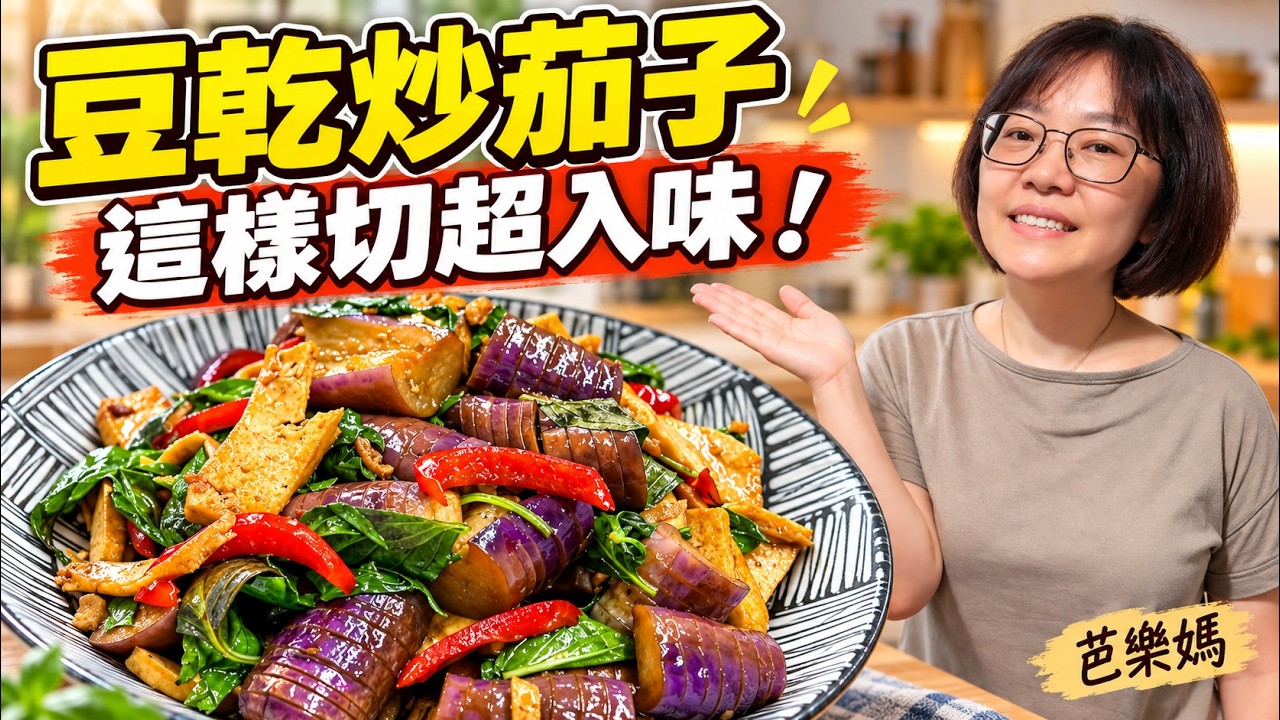
Stir-Fried Eggplant with Dried Tofu — 豆乾炒茄子
Ingredients
Method
- Trim the stem, halve the eggplant lengthwise, then lay a chopstick along each side as a depth guard. Cut fine grooves down the flesh and repeat on an angle to make a crosshatch. Slice into short bite-sized segments.
- Heat 1 tbsp oil in a wide pan over medium-high heat and toss the eggplant so every surface is coated. Add water to halfway up the eggplant, cover, and cook 4 minutes. Lift out with a slotted spoon and discard the water.
- Add the remaining 1 tbsp oil to the pan with the sliced dried tofu (and vegan meatball, if using). Fry, turning, until the edges turn light golden, about 2 minutes.
- Add the red bell pepper and chili and stir 30 seconds. Add 1 tbsp Hai Shan sauce and 1 tbsp soy sauce and toss to coat, keeping the heat high so the sauce thickens rather than simmers.
- Return the eggplant and toss 40-60 seconds so the grooves absorb the sauce. Do not add water. Turn off the heat, add the Thai basil, and toss until just wilted.
- Slide onto a warm plate, spoon the pan juices over the top, and serve immediately with steamed white rice.
Notes
🌱 Why This Dish
In Chinese home kitchens, eggplant carries the nickname 吸油大王 — “the king of oil absorption” — which is exactly why it took inventive cooks to turn it into the soft, sauce-hungry vegetable that shows up on every 下飯菜 (xià fàn cài, “rice-emptying dish”) table. The scoring technique used here is a Taiwanese refinement: the ladder of grooves turns each piece into a sponge for sauce while leaving the structure intact, so the eggplant reads as tender rather than collapsed.
The other half of the dish, 豆乾 (dòu gān, dried tofu), is the backbone of Chinese Buddhist vegetarian cooking. Because it is pressed until most of the water is gone, it survives frying without falling apart and carries an almost meaty chew — which is why it appears in temple kitchens and vegetarian restaurants as the standard stand-in for shredded pork. Pairing it with eggplant gives the plate the protein and the bite that a vegetable-only stir-fry would otherwise lack.
And then there is 九層塔 (jiǔ céng tǎ), Thai basil, named for the way its flower spike stacks up like a nine-storey tower. In Taiwan it is the herb that finishes nearly every 三杯 dish and every clam or eggplant stir-fry, tossed in at the last second because its fragrance is volatile and never survives long cooking. Together with 海山醬, a sweet, mild sauce born in Taiwan’s roadside noodle stalls, these three ingredients make a dish that tastes distinctly Taiwanese — humble, inexpensive, and built around rice. It is the kind of cooking that Buddhist 素食 traditions and everyday family kitchens share: no meat, no compromise on flavor.