 Dou Dou (豆豆)

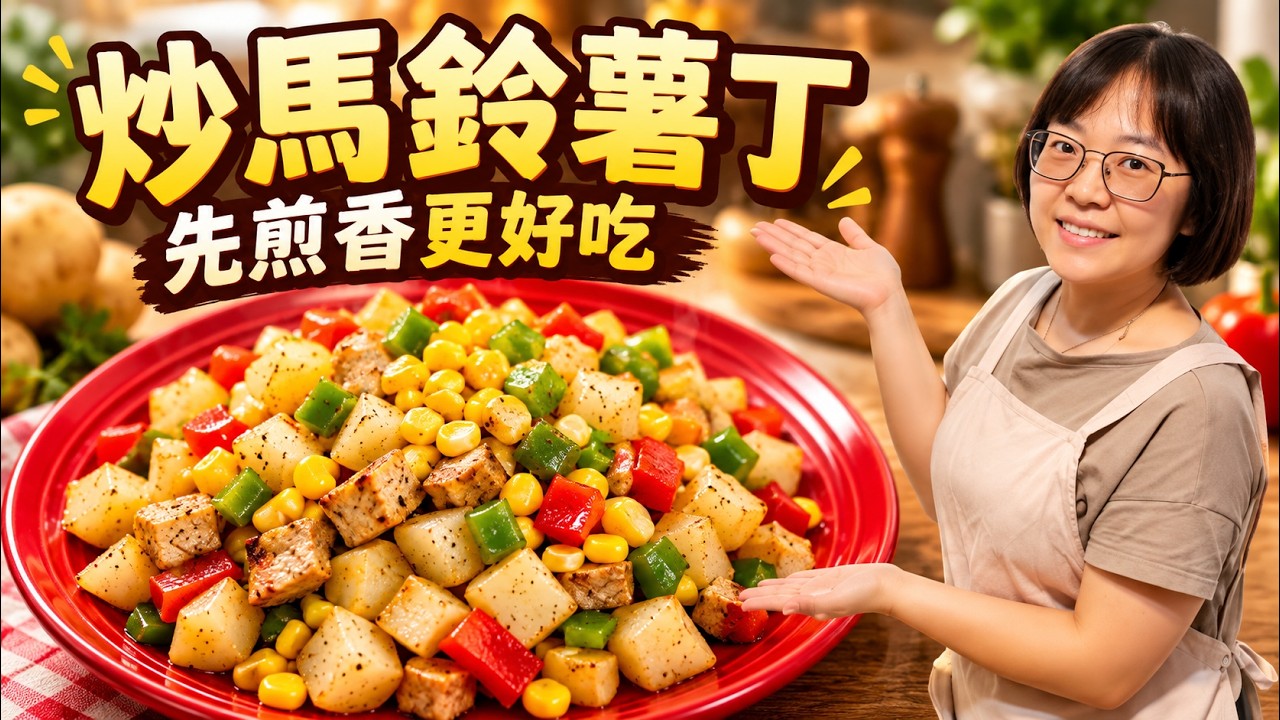
One humble potato, diced and pan-fried until golden, tossed with chewy dried tofu, wood ear and sweet peppers — finished with a whisper of curry powder. 一顆馬鈴薯也能變出香氣十足的家常菜:先煎到金黃,再和豆乾、木耳、彩椒一起炒出咖哩香。
📹 Watch the Recipe
Recipe by 芭樂媽的家 Qistin Wong TV
🥘 Why This Recipe Works
This is a Taiwanese home cook’s answer to a very ordinary problem: what do you do with a single potato? 炒馬鈴薯丁 (chǎo mǎlíngshǔ dīng) means simply “stir-fried diced potato,” and the brilliance of the dish is in the order of operations. The potato goes into the wok first, with nothing else, and gets pan-fried over medium heat until eight or nine parts of every cube is golden. That sear is the whole point — Qistin compares the finished bites to seasoned French fries, and she is right. Steam or boil the potato soft and you get a flat, mealy mush; fry it golden and you get a nutty, crisp-edged base that tastes far bigger than it costs.
The supporting cast is built for contrast. Taiwanese dried tofu (豆乾, dòu gān) — pressed, dried and usually pre-braised, so it is firm and savory — brings protein and a satisfying chew. Wood ear (黑木耳, hēi mù’ěr) adds a soft, gelatinous “QQ” snap that no other vegetable imitates. Shiitake supplies the aromatic backbone; sweet red and yellow peppers bring color so the plate looks appetizing before a single bite. A little curry powder is the quiet signature: it does not turn the dish into a curry, it just lifts the whole pan with warmth and fragrance.
Crucially, there is no garlic, onion or scallion anywhere in it. Because shiitake is fried on its own to bloom its aroma, the dish never tastes like it is missing anything — which makes it fully plant-based and free of the five pungent vegetables (五辛) that Buddhist kitchens avoid.
This version: 9 ingredients, one wok, about 20 minutes.
🛒 Ingredients
| Potato (馬鈴薯) | 1 large (~250g) | Peeled, cut into even 1 cm dice — the star of the dish |
| Dried tofu (豆乾) | ~150g | Use the braised/seasoned kind if you can; dice to match the potato |
| Fresh shiitake (香菇) | 3–4 caps | Diced; fried first to build the aroma in place of garlic |
| Wood ear (黑木耳) | ~50g (soaked if dried) | Cut into small pieces — adds the QQ texture |
| Red bell pepper (紅彩椒) | 1/2 pepper | Diced small, for color |
| Yellow bell pepper (黃彩椒) | 1/2 pepper | Diced small, for color |
| Cooking oil (食用油) | 2–3 tbsp | Enough to pan-fry the potato golden, not deep-fry |
| Salt (鹽) | 1 tsp | |
| White pepper (胡椒粉) | 1/2 tsp | |
| Curry powder (咖哩粉) | 1/2 tsp | A dry spice sprinkle, not a sauce — this is the aroma |
| Soy sauce (醬油) | 1 tbsp | Added last for depth and a little color |
| Water (水) | 1 tbsp | Just a splash to soften the potatoes at the end |
| Optional: cilantro (香菜) | a few sprigs | To garnish |
| Optional: sweet corn (玉米) | a handful | If you have it — adds sweetness and more color |
👨🍳 Instructions
Step 1: Dice everything the same size
- Peel the potato, cut it into thick slices, trim away any bruised or sunken spots, then cut into thick batons and finally into 1 cm dice.
- Dice the dried tofu the same way — if the block is thick, split it horizontally first, then into strips, then into cubes.
- Cut the wood ear into strips, then rotate and slice into small pieces; dice the shiitake caps and the peppers to match.
- Keeping every piece the same size means nothing overcooks or undercooks, and every bite has the same mix of textures.
Step 2: Fry the potatoes golden, first and alone
- Heat a couple of tablespoons of oil in a wok over medium heat and add the potato dice before anything else — potato takes longest to cook.
- Fry, stirring and spreading, until roughly 80–90% of each cube is golden brown. This can take several minutes; be patient.
- Do not splash in water to speed it up. The golden crust is the flavor — that is what makes the finished dish taste like seasoned fries.
Step 3: Bloom the shiitake
- Once the potato is more than half cooked, push it to one side and add the diced shiitake to the open space.
- Fry the shiitake on its own until fragrant and lightly browned — it has not been fried yet, and this is where the dish’s aroma comes from in the absence of garlic.
- Then stir the shiitake through the potato.
Step 4: Add tofu, wood ear and peppers
- Add the dried tofu cubes and the wood ear; toss and fry for a minute or two so the tofu picks up color.
- Add the red and yellow pepper dice last — they only need to be warmed through and slightly softened.
- Give everything a good toss so the colors are evenly distributed.
Step 5: Season with curry, then soy
- Sprinkle in 1 tsp salt, 1/2 tsp white pepper and 1/2 tsp curry powder; toss fast to coat every piece evenly while the pan is hot.
- Let the dry spices toast for a moment, then add 1 tbsp soy sauce and toss again — you should smell the curry the moment it hits the pan.
Step 6: Splash, soften, plate
- Add 1 tbsp water, toss once, and let it bubble for a few seconds so the potatoes finish softening and all the flavors marry.
- Switch off the heat as soon as the water has mostly evaporated — do not let it stew.
- Plate and scatter a little cilantro on top for freshness, then serve hot with rice.
💡 Tips & Substitutions
| Potato came out soft and bland | You steamed or boiled it instead of frying it golden. The deep sear in Step 2 is what gives the dish its aroma — fry until 80–90% golden before adding anything else. |
| Short on time | Spray the potato dice with a little oil and air-fry them first while you prep the rest, then finish everything in the wok. Nearly the same result, hands-free during the air-fry. |
| No red bell pepper, and you like heat | Swap it for fresh chili — the sweetness of the pepper is the only thing you lose, and the curry loves a little spice. |
| Want it a bit more substantial | Add a handful of sweet corn kernels with the peppers, or extra dried tofu. Both stretch the dish without changing its character. |
📊 Nutrition
Per serving (serves 3 as a side, or 2 as a main with rice)
~230 cal · Protein: 11g · Carbs: 19g · Fat: 13g · Fiber: 4g
Ingredients
Method
- Peel the potato, cut into thick slices, trim bruised spots, then into batons and finally 1 cm dice. Dice the dried tofu the same way (split thick blocks horizontally first). Cut the wood ear into small pieces, and dice the shiitake caps and peppers to match. Uniform size means even cooking.
- Heat 2-3 tbsp oil in a wok over medium heat and add the potato dice before anything else. Fry, stirring and spreading, until about 80-90% of each cube is golden brown — several minutes. Do not add water; the golden crust is the flavor.
- When the potato is more than half cooked, push it aside and add the diced shiitake to the open space. Fry it alone until fragrant and lightly browned — this builds the aroma in place of garlic — then stir it through the potato.
- Add the dried tofu and wood ear; toss and fry a minute or two so the tofu picks up color. Add the red and yellow pepper dice last and toss to distribute the colors evenly.
- Sprinkle in 1 tsp salt, 1/2 tsp white pepper and 1/2 tsp curry powder and toss fast to coat evenly. Let the dry spices toast briefly, then add 1 tbsp soy sauce and toss again.
- Add 1 tbsp water, toss, and let it bubble a few seconds so the potatoes finish softening and the flavors marry. Switch off the heat once the water has mostly evaporated. Plate, scatter with cilantro and serve hot with rice.
Notes
🌱 Why This Dish
馬鈴薯丁 (mǎlíngshǔ dīng) belongs to the large family of Chinese 家常菜 (jiācháng cài) — “everyday home dishes” — the quick, thrifty stir-fries a Chinese household cooks on a weeknight from whatever is in the fridge. The name is purely descriptive: 馬鈴薯 is the Chinese word for potato (literally “horse-bell tuber,” from the bell-like shape of the plant’s seed pods), and 丁 means “dice.” So 炒馬鈴薯丁 is exactly what it says: stir-fried diced potato. What elevates it above a plain vegetable fry is that the cook treats the potato as the centrepiece, frying it for its own sake rather than as an afterthought.
The curry powder is a distinctly Taiwanese touch. Curry arrived in Taiwan through the Japanese colonial period (1895–1945), and 咖哩粉 became a pantry staple in Taiwanese home kitchens — but not as the base of a sauce. Instead it is used as a dry spice rub or finishing sprinkle, a mild, turmeric-forward blend that perfumes a stir-fry without thickening it. That is why half a teaspoon is enough here: the dish stays a clean, savory vegetable fry with a warm curry echo rather than becoming a curry.
In Buddhist vegetarian cooking, dishes like this are valued precisely because they are 五辛-free — no garlic, onion, scallion, chives or leek, the five pungent vegetables that are believed to agitate the mind during meditation. Instead the cook builds savoriness from dried tofu and shiitake, and texture from wood ear. The result is a homely plate that is simultaneously 全素 (fully vegan), cheap, fast, and — as the cook herself notes — tastes unexpectedly like well-seasoned fries tossed with tofu. It is the kind of modest dish that fills the table at a temple refectory or a family dinner, proof that a single potato and a good hand with a wok go a long way.