 Dou Dou (豆豆)
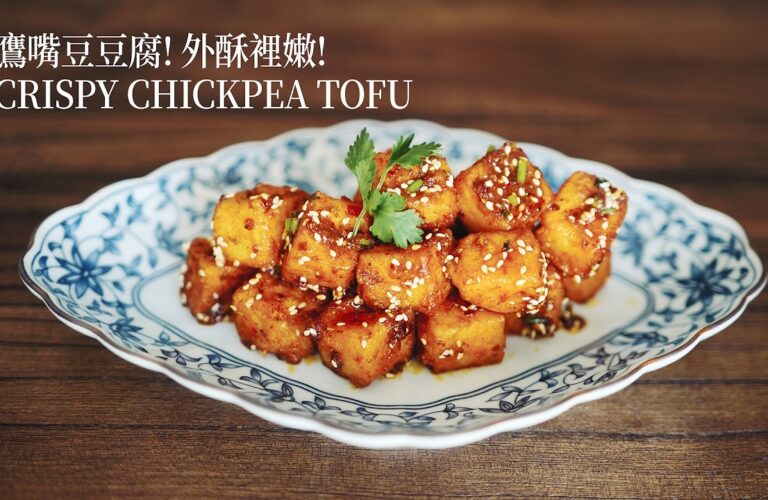
Dried chickpeas become a silky, sliceable “tofu” that fries up with a crust you can hear — then meets a spicy cumin sesame sauce. 干鹰嘴豆能变成细腻可切的“豆腐”,炸出听得见的酥壳,再拌上香辣孜然麻酱。
📹 Watch the Recipe
Recipe by Chu's Vegan
🥘 Why This Recipe Works
Chickpea tofu (鹰嘴豆豆腐, yīngzuǐdòu dòufu) is the oldest trick in the meatless kitchen: treat a legume exactly the way you treat soybeans. Soak it, grind it with water, boil the milk, let it set. The result is a firm, pale block that looks like tofu but tastes like the bean it came from — faintly sweet, nutty, and creamy at the center. In Chinese temple cooking this family of “seed tofus” (花生豆腐, 黑豆豆腐, 鹰嘴豆豆腐) has fed vegetarians for centuries, because it delivers the protein and the satisfying chew of meat without any of it.
What makes this version worth cooking is the double fry. A thin coat of cornstarch and a first pass at 160°C sets the block so it holds its shape; a second pass at 180°C drives the moisture out and turns the shell glassy-crisp, while the inside stays dense and creamy. The sauce does the rest — chili powder, sesame, and cumin bloomed in hot oil, sharpened with black vinegar, deepened with fermented tofu liquid (腐乳汁). That fermented bean liquid is the quiet hero: it gives the sauce the savory funk that garlic and oyster sauce normally would, so the dish stays fully Buddhist-vegetarian and free of the five pungent vegetables.
This version: 4 pantry ingredients for the tofu, one small bowl of sauce, about 25 minutes of hands-on cooking (plus soaking and chilling time).
🛒 Ingredients
| Dried chickpeas (鹰嘴豆) | 150 g | Soaked at least 8 hours in the fridge until they crush easily between your fingers |
| Water (清水) | 400 g | For blending the chickpea milk |
| Cornstarch (玉米淀粉) | As needed, about 3-4 tbsp | Thin coat only — a heavy coat makes the crust pasty |
| Frying oil (食用油) | As needed, about 500 ml | Neutral oil; you fry twice at 160°C then 180°C |
| Chili powder (辣椒面) | 1 tbsp | Coarse Chinese/Korean flakes, not fine cayenne |
| White sesame seeds (白芝麻) | 1 tbsp | Toasted is better; they go into the hot-oil bloom |
| Cumin, coarsely ground (孜然面) | 1 tsp | Half-crushed seeds give fragrance plus little pops of texture |
| Cilantro with roots (香菜碎带根) | 2 tbsp | Chop the roots finely too — that is where the aroma lives |
| Soy sauce (生抽) | 1 tbsp | Light/regular, for salt and body |
| Brown sugar (赤砂糖) | 1 tsp | Rounds off the chili and vinegar |
| Chinese black vinegar (香醋) | 1/2 tsp | Chinkiang vinegar; a small amount lifts the whole bowl |
| Chili oil (红油) | 1 tbsp | For the finished sauce — this is separate from the blooming oil |
| Fermented tofu liquid (腐乳汁) | 1 tbsp | Brined white fermented tofu; the umami anchor of the sauce |
| Salt (竹盐) | 1/2 tsp | Fine bamboo salt or sea salt |
👨🍳 Instructions
Step 1: Soak and Blend the Chickpeas
- Rinse 150 g of dried chickpeas under cold water, then cover them with plenty of water and refrigerate at least 8 hours (overnight is easiest). They are ready when they split under light finger pressure.
- Drain well and blend with 400 g of fresh water until completely smooth — a high-speed blender for 2 full minutes, scraping down once.
- Strain the purée through a fine cheesecloth or nut milk bag, squeezing hard. You want a clean, grit-free milk; discard the pulp (or dry it for baking).
Step 2: Cook the Chickpea Milk
- Pour the milk into a heavy-bottomed saucepan and set it over medium-low heat.
- Bring it just to a boil, then keep it bubbling gently for a few more minutes, whisking nonstop along the bottom and corners — this milk scorches in seconds if you walk away.
- It is ready when it thickens enough to coat the whisk and a line drawn through it holds.
Step 3: Set the Tofu
- Pour the hot mixture into a lightly oiled or lined container and smooth the top flat.
- Cool on the counter, then refrigerate at least 3 hours — overnight gives a firmer, easier-to-fry block.
- Turn it out onto a board; it should be a solid, glossy slab that holds an edge when cut.
Step 4: Cut and Coat
- Cut the block into even 2 cm cubes. Trim off the rounded edges first so every piece fries at the same rate.
- Pat the cubes dry with paper towel — surface water is what makes oil spit and crusts flabby.
- Dust lightly all over with cornstarch, then shake in a sieve to knock off the excess.
Step 5: Double-Fry for the Crust
- Heat the oil to about 160°C. Fry the cubes in batches without crowding until set and pale gold, then lift them out to drain.
- Raise the oil to about 180°C and fry the same cubes a second time, 30-60 seconds, until deeply golden and audible-when-you-stir crispy.
- Drain on a rack (not on paper, which steams the crust) while you make the sauce.
Step 6: Build the Sauce and Toss
- In a heatproof bowl combine the chili powder, sesame seeds, ground cumin, and chopped cilantro.
- Pour a small ladle of hot oil over the aromatics — it should hiss and smell immediately fragrant. Then stir in the soy sauce, brown sugar, black vinegar, chili oil, fermented tofu liquid, and salt, and whisk into a glossy dark-red dressing.
- Pour the sauce over the hot fried cubes and fold gently with a spatula until every piece is coated. Serve right away — this dish is at its best in the first ten minutes.
💡 Tips & Substitutions
| My chickpea milk scorched and tastes burnt | Medium-low heat and constant whisking, never high heat. A heavy-bottomed or nonstick pan buys you a minute of forgiveness. If it does catch, pour the milk into a clean pot without scraping the bottom. |
| The cubes fall apart in the oil | The block was not chilled long enough or the surface was wet. Chill 3 hours minimum (overnight is best), dry every cube, and keep the first fry at a gentle 160°C so the shell sets before the inside softens. |
| Not crispy enough | Fry twice. The first fry cooks and sets, the second fry at 180°C dries the crust. Also drain on a rack, never a paper-lined plate, and sauce at the last second. |
| No fermented tofu liquid on hand | Use 1 tsp white miso, or 1/2 tsp mushroom seasoning (香菇粉) plus a splash more soy sauce. Both keep the sauce fully plant-based and allium-free. |
| Shortcut: no time to soak dried chickpeas | Blend 100 g of chickpea flour (鹰嘴豆粉) with 400 g cold water until lump-free, then cook it the same way from Step 2. Slightly less sweet, but it works on a weeknight. |
📊 Nutrition
Per serving (serves 3 as a side, or 2 as a main with rice)
~340 cal · Protein: 11 g · Carbs: 31 g · Fat: 18 g · Fiber: 8 g
Estimated from the ingredient list — chickpeas supply most of the protein and all of the fiber, while roughly a third of the fat comes from the fry and the sauce oils.
Ingredients
Method
- Rinse 150 g dried chickpeas, cover with water and refrigerate at least 8 hours until they crush easily under finger pressure. Drain and blend with 400 g fresh water for 2 minutes until completely smooth. Strain through a fine cheesecloth or nut milk bag, squeezing hard, to get a grit-free chickpea milk.
- Pour the milk into a heavy-bottomed saucepan over medium-low heat. Bring just to a boil, then keep it bubbling gently for a few more minutes, whisking nonstop along the bottom and corners. It is ready when it thickens enough to coat the whisk.
- Pour into a lightly oiled or lined container and smooth the top. Cool, then refrigerate at least 3 hours (overnight gives a firmer block). Turn out onto a board - it should hold an edge when cut.
- Cut into even 2 cm cubes, trimming the rounded edges first. Pat dry with paper towel, then dust lightly all over with cornstarch and shake off the excess in a sieve.
- Heat oil to about 160C and fry the cubes in batches until set and pale gold; lift out to drain. Raise the oil to about 180C and fry a second time, 30-60 seconds, until deeply golden and crisp. Drain on a rack.
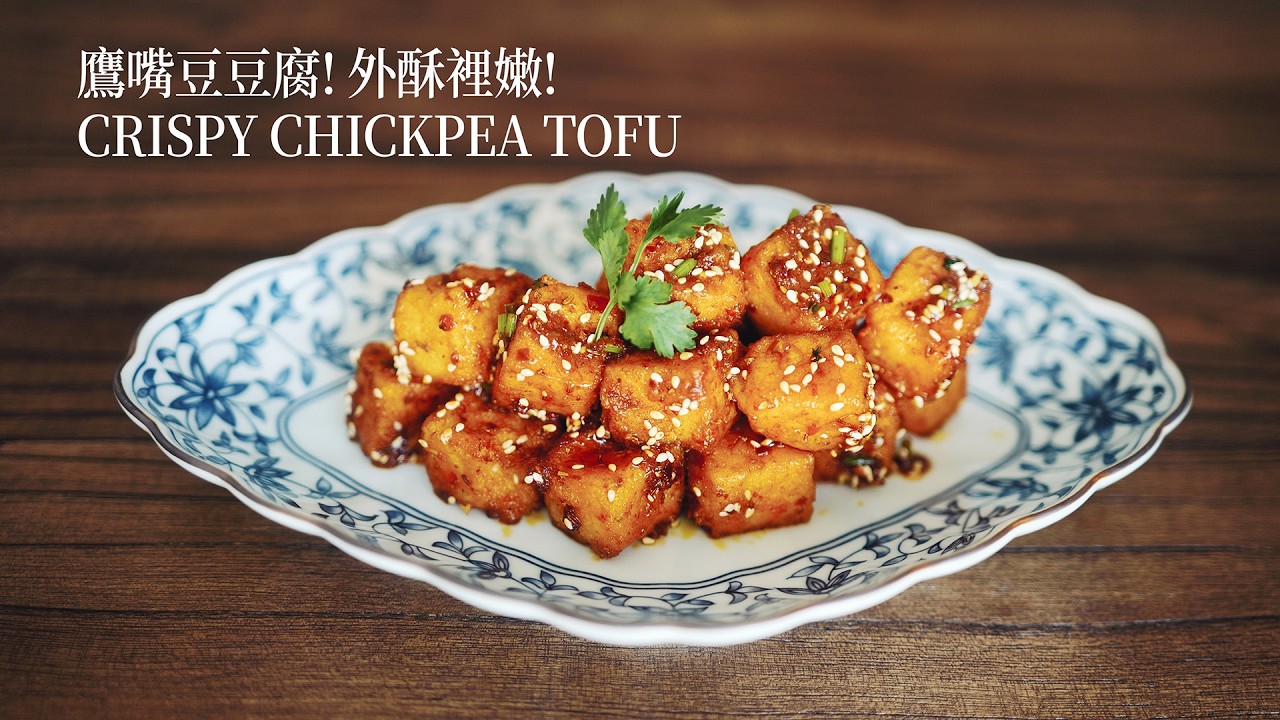
- Combine chili powder, sesame seeds, ground cumin and cilantro in a heatproof bowl. Pour a little hot oil over them to bloom the aromatics, then stir in soy sauce, brown sugar, black vinegar, chili oil, fermented tofu liquid and salt. Pour over the hot fried cubes, fold gently to coat, and serve immediately.
Notes
🌱 Why This Dish
The name 鹰嘴豆 means “eagle-beak bean” — after the little pointed hook on each seed — and it tells you this is a crop that travelled: it reached China along the Silk Road and settled into northwestern and Hui (回回) kitchens, where it is still boiled, spiced, and eaten by the handful as 桃豆. Turning it into tofu (鹰嘴豆豆腐) was the natural next step for cooks who already knew how to coax a set curd out of soybeans and peanuts.
In Buddhist temple cuisine, these legume “tofus” matter for a practical reason: they let a vegetarian table carry the weight of a meal. A block made from 150 g of beans holds the protein of a bowl of meat, slices like meat, and takes on the heat of chili and cumin — which is exactly what the sauce here does. The fermented tofu liquid stands in for the garlic, scallion, and oyster sauce that a non-vegetarian cook would reach for, so the dish stays free of the five pungent vegetables (五辛) and can be served to monks and lay practitioners alike. Nothing about it feels like a compromise, which is the whole point of the tradition: 素菜 should not taste like an apology.