 Dou Dou (豆豆)
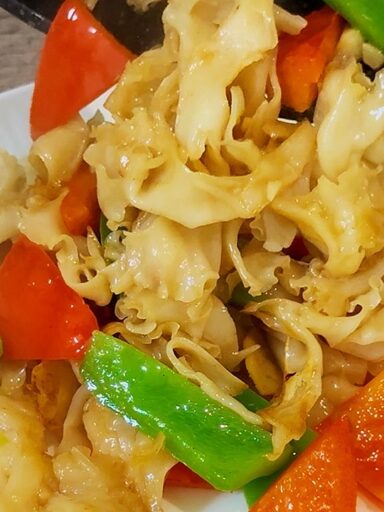
Pan-fried golden cubes of potato tossed with savoury soy mince, crisp cucumber and fragrant beech mushrooms in a glossy Malaysian-style sauce — a humble 家常菜 (home-style dish) that disappears with rice. 將馬鈴薯煎至金黃焦香,配搭大豆素肉末、雪白菇與小黃瓜快炒,鹹香下飯,簡單又滿足。
📹 Watch the Recipe
Recipe by 芭樂媽的家 Qistin Wong TV
🥘 Why This Recipe Works
This is the kind of dish that makes you rethink the humble potato. In Chinese home cooking, there is a prized quality called 下飯 (xiàfàn) — food so flavourful it begs for another scoop of rice. 馬鈴薯炒素肉碎 (mǎlíngshǔ chǎo sù ròusuì, “potatoes stir-fried with veggie mince”) delivers exactly that: potatoes are first pan-fried until their edges turn golden and translucent, unlocking a wok-fragrant crust far better than plain blanched spuds. The soy mince rehydrates to a chewy, meaty bite, while cucumber and white beech mushrooms keep every mouthful light and refreshing.
What makes this dish special is its Malaysian-Chinese personality. Qistin Wong finishes it with a splash of 黑醬油 (dark soy sauce), beloved across Malaysia for stirring into savoury rice dishes, plus a spoon of ketchup that adds a subtle sweet-tangy note. Deeper than the sauce, though, is the cooking philosophy: fry, sear, and only then season — each ingredient gets its moment to shine so the final dish tastes layered rather than muddy.
This version: 9 ingredients, one pan, 25 minutes.
🛒 Ingredients
| Potatoes (馬鈴薯) | 2 medium | Peeled, cut into small cubes |
| Dried soy veggie mince (大豆素肉末) | 1 handful | Soaked, rinsed, squeezed dry |
| Cucumber (小黃瓜) | 1 | Diced to match potato size |
| White beech mushrooms (雪白菇) | ¼ pack | Trimmed and halved |
| Vegan oyster sauce (素蠔油) | 1 tbsp | Umami base |
| Soy sauce (醬油) | 1 tsp | Salty backbone |
| Ketchup (番茄醬) | 1 tbsp | Sweet-tangy lift |
| Dark soy sauce (黑醬油) | 1 tsp | Colour and caramel aroma |
| White pepper (白胡椒粉) | ¼ tsp | Gentle heat |
| Water (清水) | 60 ml | To marry the sauce |
| Cooking oil (食用油) | 2–3 tbsp | For pan-frying |
| Optional: Red chili (辣椒) | to taste | For extra heat |
👨🍳 Instructions
Step 1: Prep the vegetables
- Peel the potatoes and cut into thick slices, then strips, then roughly 1 cm cubes — a finger-width dice cooks evenly and holds its shape.
- Dice the cucumber into pieces about the same size as the potato cubes.
- Trim the root end of the white beech mushrooms and halve them.
Step 2: Rehydrate the soy mince
- Soak a handful of dried soy mince in water until it swells — it expands quite a bit, so don’t overdo the amount.
- Rinse it 2–3 times until the water runs fairly clear, then squeeze out the excess moisture firmly.
Step 3: Pan-fry the potatoes golden
- Heat a generous amount of oil in a wok or pan and add the potato cubes.
- Let them fry undisturbed for about a minute, then flip; repeat until golden and slightly translucent on the surface.
- Scoop out the potatoes and set aside — reserve some of the oil in the pan.
Step 4: Fry the mince and mushrooms
- With the pan over medium-high heat, add the rehydrated soy mince and stir-fry until fragrant and lightly browned — cooking off any raw “beany” taste while drawing out a nutty aroma.
- Add the beech mushrooms (add a touch more oil if the pan looks dry) and fry until they’re just golden at the edges.
Step 5: Combine and season
- Return the potatoes to the pan, add the cucumber, then toss in 1 tsp soy sauce, 1 tbsp vegan oyster sauce and 1 tbsp ketchup.
- Stir quickly to bloom the seasonings, then pour in 60 ml of water and toss fast over high heat so every piece gets coated and seasoned.
Step 6: Finish and serve
- Season with ¼ tsp white pepper and add about 1 tsp of dark soy sauce for a deep gloss.
- Toss everything quickly once more, then serve piping hot over steamed rice. For spice lovers, fold in a few slices of fresh red chili.
💡 Tips & Substitutions
| No vegan oyster sauce on hand? | Swap in 1 tbsp mushroom stir-fry sauce, or combine 1 tbsp soy sauce with 1 tsp sugar and a splash of water. |
| Can’t find dried soy mince? | Crumble extra-firm tofu and pan-fry until golden, or use finely chopped button mushrooms with a pinch of five-spice for a meaty texture. |
| My potatoes break apart while frying. | Cut larger, even cubes and don’t stir too eagerly — let them sit to develop their golden crust before flipping. |
| Want it spicier? | Add sliced red chili or a pinch of chili flakes right at the end so the heat stays bright and fresh. |
📊 Nutrition
Per serving (serves 3 as a main with rice)
~220 cal · Protein: 11g · Carbs: 26g · Fat: 9g · Fiber: 4g

Ingredients
Method
- Peel the potatoes and cut into thick slices, then strips, then roughly 1 cm cubes. Dice the cucumber into similar-size pieces. Trim and halve the white beech mushrooms.
- Soak a handful of dried soy mince in water until it swells. Rinse 2–3 times until the water runs fairly clear, then squeeze out excess moisture firmly.
- Heat a generous amount of oil in a wok or pan and add the potato cubes. Let them fry undisturbed for about a minute, then flip; repeat until golden and slightly translucent. Remove and set aside, keeping some oil in the pan.
- Add the rehydrated soy mince to the pan and stir-fry until fragrant and lightly browned. Add the beech mushrooms (a touch more oil if dry) and fry until golden at the edges.
- Return the potatoes, add the cucumber, then add 1 tsp soy sauce, 1 tbsp vegan oyster sauce and 1 tbsp ketchup. Stir to bloom the seasonings, pour in 60 ml water and toss fast over high heat.
- Season with ¼ tsp white pepper and about 1 tsp dark soy sauce for a deep gloss. Toss once more and serve hot over steamed rice. For spice, fold in sliced fresh red chili.
Notes
🌱 Why This Dish
In Chinese vegetarian tradition, 素肉 (sù ròu) — “vegetarian meat” — has been made for centuries, originally by Buddhist monks as a way of keeping the meatless 齋 (zhāi) table generous without breaking monastic precepts. Rehydrated soy mince belongs to this long lineage: humble, thrifty, and endlessly adaptable, it lets a home cook deliver the satisfying chew people crave from meat while staying fully plant-based. Here the technique is pure wok 鍋氣 (guō qì) — “wok breath” — that elusive smokiness and caramelised fragrance a hot pan gives you, which is exactly why the potatoes are fried golden before anything else touches the wok.
The 下飯 concept behind this dish is central to Chinese home cooking: a meal isn’t fussed over for its presentation but for whether it makes rice disappear. Across Malaysia, where Qistin Wong’s family-style cooking lives, a stir-fry like this — glossy with dark soy, kissed with ketchup, and blessed with white pepper — is everyday comfort. It is the kind of plate served on busy weeknights, temple feasts, and family tables alike, proof that plant-based food needs nothing fancy to be deeply satisfying.